You’d think driving without insurance would be as rare as a rust-free classic car, yet millions hit the road every day with zero coverage. I’ve spent years comparing state requirements, and here’s what actually matters: nearly every state forces you to carry liability insurance, typically $25,000 per person and $50,000 per accident for injuries, plus another $25,000 for property damage.
But here’s the catch: those minimums won’t save your assets if you total a luxury SUV or cause serious injuries. Some states demand extras like uninsured motorist coverage or personal injury protection, while others let you self-insure with cash bonds. The penalties? Think license suspension, hefty fines, and potential jail time. I’ll break down exactly what your state requires and why skimping could cost you everything.
Minimum Car Insurance Required in Every State
Nearly every state in the country forces you to carry car insurance if you want to drive legally, and I’ve spent enough time comparing policies to know these minimums aren’t suggestions; they’re hard requirements with real consequences if you ignore them. Each state sets its own state insurance requirements, so your minimum liability limits depend entirely on where you register your vehicle.
Most states demand bodily injury coverage around $25,000 per person and $50,000 per accident, plus property damage liability between $20,000 and $25,000. I make sure to carry proof of insurance in my glovebox, no exceptions.
Some jurisdictions mandate uninsured/underinsured motorist protection, while no-fault states require personal injury protection regardless of who’s responsible. These rules keep us all protected on the road together.
Recommended Products
![ESSENTIAL Car Auto Insurance Registration BLACK Document Wallet Holders 2 Pack - [BUNDLE, 2pcs] - Automobile, Motorcycle, Truck, Trailer Vinyl ID Holder & Visor Storage - Strong Closure On Each -](https://m.media-amazon.com/images/I/41k-QvzFVuL._SL500_.jpg)
ESSENTIAL Car Auto Insurance Registration BLACK Document Wallet Holders 2 Pieces

💼 CAR ORGANIZER PRACTICALITY: Car registration and insurance holder has multi-function clear compartments which can organize various items very well. The car document holder large pocket for insurance documents and 2 pockets for vehicle registration, 3 small pockets for driver's license, ID cards, AAA cards, business cards, receipt, key contact information cards, etc. It can fully meet your needs

【HIGH QUALITY】: made of premium PU leather and durable vinyl PVC, strong and firm enough for your long-term use.
Liability Limits: How Much Coverage Your State Mandates
I’ll walk you through how states set their liability minimums, because these numbers directly affect your financial risk after an accident. Most states require bodily injury coverage around $25,000 per person and $50,000 per accident, plus property damage limits typically between $20,000 and $25,000.
I’ve seen these minimums fall short in real crashes, so I’ll explain why matching your state’s floor might leave you exposed, and how to read your declaration page for the actual protection you’re buying.
Recommended Products


DURABLE ALUMINUM: Not Responsible For Parking Lot Sign is made from heavy-duty, 40 mil thick aluminum. Unlike steel signs, our aluminum signs do not rust. Signs last up to 7 years outside.

State Minimum Requirements
How much coverage do you actually need to drive legally? I’ve found that state minimums vary widely, so you’ll need to check your specific requirements. Most states mandate liability coverage with bodily injury limits around $25,000 per person and $50,000 per accident, plus property damage coverage near $20,000 to $25,000. Some states also require uninsured/underinsured motorist protection.
New Hampshire stands alone as the only state without mandatory car insurance, though you’ll still need to prove financial responsibility if you cause a crash.
State minimums protect you legally, but often fall short in real accidents. Uninsured/underinsured coverage shields you from drivers who skip insurance. Financial responsibility laws ensure victims get compensated, even without traditional policies.
Bodily Injury Limits
Bodily injury limits sit at the heart of your liability coverage, defining exactly how much protection you’re buying for someone else’s medical bills and lost income when you’re at fault. These limits break down into two numbers: per person and per accident. For example, Illinois sets minimum liability insurance at $25,000 per person and $50,000 per accident.
I’ve watched state requirements vary dramatically, from bare-bones protection to stronger mandates where medical costs run higher. Your insurance premiums directly reflect these choices; lower limits mean lower payments, but also bigger personal risk.
Here’s where uninsured motorist coverage becomes essential. When an at-fault driver carries skimpy limits, this add-on protects you. Even in no-fault states, bodily injury limits matter for serious crashes exceeding Personal Injury Protection thresholds.
Property Damage Thresholds
Where does your state draw the line when someone else’s car, fence, or storefront ends up crushed under your bumper? I break down property damage liability so you know exactly where you stand.
State requirements vary widely. Some match property damage minimums to bodily injury limits, others set separate floors. Illinois minimums require $20,000 per accident, but your state could demand more or less. I check my property damage threshold against auto insurance law before every renewal.
This coverage pays for damage I cause to others’ property, not my own vehicle. That’s what collision and comprehensive handle, and those remain optional.
Penalties for non-compliance hit hard: fines, suspended licenses, registration headaches. I don’t risk it.
Review your declarations page annually; minimum limits that felt adequate five years ago may leave you exposed today. Consider umbrella coverage if your assets exceed your state’s floor; I’ve seen $20,000 evaporate on a single fender-bender. Document every vehicle and structure at your home; accurate records speed claims when property damage liability activates.
No-Fault vs. At-Fault: How Your State Handles Claims
I need to compare how state systems handle claims so you know exactly what insurance you’re required to carry. In no-fault states, you’ll file injury claims with your own insurer through Personal Injury Protection, typically $10,000 to $50,000 in required coverage. At-fault states make the responsible driver’s liability policy pay.
This distinction determines whether you’re shopping for strong PIP protection or prioritizing higher liability limits. I’ve found it changes how quickly you’ll see claim payouts after an accident.
Recommended Products

[SMALL NESTING 2-PACK] Includes one 9.2" × 5.7" bag and one 8" × 5" pouch that nest together for double-layer thermal protection. Fits cash, passports, IDs and small valuables. Does NOT fit A4 or Letter paper without folding

100% Fireproof & Water Resistant: This UL certified upgraded fireproof bag is constructed primarily of fire-resistant, heat-insulating functional materials that can withstand ultra-high temperatures. Meantime, the Sealed zippers are totally waterproof which can survive the spray of firefighter's hose on full blast, provides 360° security seal and maximum protection for your documents

SIZE: The synthetic leather holder is 4.7" x 6.9" (12 x 17.5 cm) open and 3.6" x 5.1" (9.2 x 13 cm) folded
State Systems Compared
Twelve states operate under no-fault insurance systems, and figuring out which camp yours falls into changes everything about how you’ll file a claim after an accident. As someone who’s dealt with the no-fault vs at-fault divide, I’ll walk you through what actually matters when you’re choosing coverage that fits your state’s rules.
In no-fault states like Florida or Michigan, you’re required to carry Personal Injury Protection, covering your medical bills regardless of who caused the crash. At-fault states put liability on the driver who caused damage.
Here’s where mandatory insurance gets personal:
- Minimum coverage requirements vary wildly by state, from $10,000 to $50,000 in liability limits
- Uninsured/underinsured motorist protection fills gaps when the other driver disappears
- State insurance laws in New Hampshire allow skipping coverage entirely, though proving financial responsibility becomes your burden
Know your system, buy smart.
Claim Filing Rules
State systems set the rules, but filing the claim is where you’ll feel the difference in your wallet and your timeline.
In at-fault states, you’ll pursue the other driver’s bodily injury coverage when they’re responsible. In no-fault states, including Florida, Michigan, and New York, you’ll file with your own insurer through PIP coverage regardless of who caused the crash.
This liability vs no-fault divide changes everything. No-fault states simplify claim filing rules, reducing lawsuits but limiting your right to sue. Some, like Kentucky and Pennsylvania, let you opt out of PIP requirements.
You’ll still need uninsured motorist protection in both systems. At-fault states keep fault determination central to payouts, while no-fault status shifts which coverages apply. Understanding your state’s approach prevents surprises when you need coverage most.
Uninsured Motorist Coverage: Where It’s Required
Where exactly does uninsured motorist coverage become mandatory rather than optional? I’ve found that roughly twenty states make Uninsured Motorist coverage required by law, not just a smart add-on.
When your state mandates it, you’ll typically need to match your bodily injury limits, often 25/50 or similar. Some places let you opt-out with a signed form, but I wouldn’t recommend it. You’re essentially gambling that every driver carries proper insurance.
Here’s what this protection really provides for our community:
- Hit-and-run protection when the other driver vanishes
- Underinsured Motorist coverage for gaps when their policy falls short
- Peace of mind knowing you’re not left paying for someone else’s mistake
Check your state’s rules. The small premium increase beats absorbing medical bills from an uninsured driver’s crash.
Recommended Products

Protect Your Documents: Car registration and insurance holder protects documents from wear and tear, takes up little space in the glove compartment or on the visor. It enables your essential vehicle and insurance paperwork organized and easily accessible.


【Document well organized】 Perfect designed auto car document holder, keeps all important document such as registration and insurance card, business cards, emergency information, paperwork, gas card well organized and looks much better than just scattered in the glove box.
PIP and Medical Payments: Mandatory in These States
After confirming whether your state forces uninsured motorist coverage on you, I turn to another requirement that hits your wallet directly: Personal Injury Protection.
I’ve found that PIP is mandatory in no-fault states, where auto insurance laws require your own policy to cover your medical expenses regardless of who caused the crash. State requirements vary significantly here. Some no-fault states demand strong PIP coverage limits, while others let you opt out entirely.
Medical payments coverage works similarly but follows different rules. Only Maine makes medical payments mandatory, though I recommend checking your specific state’s stance. When shopping, verify exact coverage limits, as these minimums differ by location.
Don’t assume you’re done once you grab basic liability. PIP and medical payments can protect your finances after an accident, so factor them into your budget before you sign.
Recommended Products


POWERFUL BURST OC SPRAY - Our high quality pepper spray is pressurized higher than most to give strong 10-12 ft multiple blasts. No need to worry about weak drizzle when fired; a small pepper spray unit you can rely on

Physical Damage: When Collision and Comprehensive Are Required
How exactly does physical damage coverage become mandatory when state laws stay silent on it? I found out the hard way when I bought my first financed vehicle. While collision and comprehensive aren’t required by law at the state level, lenders absolutely demand them. They want their asset protected.
Here’s what I’ve learned about protecting your ride and your wallet:
Collision covers crashes with cars, trees, guardrails, whatever you hit, fixing your vehicle regardless of who’s at fault. Comprehensive handles theft, hail, fire, vandalism, the random disasters you can’t predict. Your deductible choice directly impacts monthly payments and out-of-pocket costs when filing claims.
Lenders typically require both coverages until you pay off your loan. Some even specify minimum coverage levels or maximum deductibles. Read your financing agreement carefully. I always recommend shopping quotes, comparing deductibles, and understanding exactly what your lender demands before driving off the lot.
Recommended Products

Protect Your Documents: Car registration and insurance holder protects documents from wear and tear, takes up little space in the glove compartment or on the visor. It enables your essential vehicle and insurance paperwork organized and easily accessible.

EASY TO READ: The car registration and insurance holder with 6 transparent pockets. Once you facing an emergency, the car registration and insurance holder can quickly show the proof in seconds
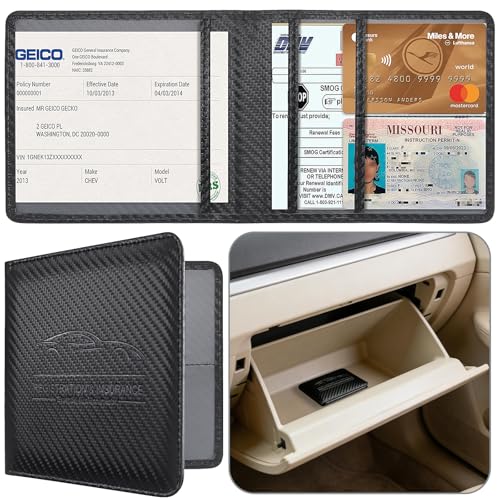
EASY TO READ: The car registration and insurance holder with 4 transparent pockets. Once you facing an emergency, the car registration and insurance holder can quickly show the proof in seconds
Skip Traditional Insurance? Self-Insurance Rules by State
California makes this concrete with a $75,000 cash deposit option, held directly with the DMV. You’re not stuck with traditional policies if you qualify for self-insurance. Several states let you prove financial responsibility through alternative methods like bonds, securities, or cash deposits instead of standard liability coverage.
In California, your options include that cash deposit, a DMV-issued self-insurance certificate, or a surety bond from a licensed company. You’ll need to contact the DMV Insurance Unit at (916) 657-6677, Option 3, to report your proof of self-insurance.
Here’s the catch: self-insurance usually targets larger fleets and businesses with serious financial backing, not everyday drivers. Most states still demand you demonstrate you can cover accident costs. Fail that test, and you’re looking at license or registration suspension.
Recommended Products

Protect Your Documents: Car registration and insurance holder protects documents from wear and tear, takes up little space in glove compartment or on the visor. It enables your important and essential vehicle and insurance paperwork organized and easily accessible

SIZE: It is 5.16*4.65 inch, which takes up a small space and can be easily placed in the glove box of the vehicle.
Proof of Insurance: What to Keep in Your Car
Whether you’re pulling out of your driveway or crossing state lines, I’ve learned that keeping valid proof of insurance within arm’s reach isn’t optional. It’s your legal shield against fines, registration holds, and roadside headaches. I carry my automobile insurance card, state minimum liability details, and current license plate registration in my glovebox, plus a digital backup on my phone. Most states accept electronic verification, but I never risk a dead battery.
Your proof of insurance is your legal shield against fines, registration holds, and roadside headaches—keep physical and digital backups ready.
If you’re high-risk or rebuilding trust after violations, you’ll need an SR-22, a specialized DMV documentation certifying your proof of financial responsibility. Some folks use cash deposits or surety bonds instead of standard policies; that requires an authorization letter from the DMV.
- Your insurance card proves state minimum liability compliance during traffic stops
- An SR-22 serves as court-ordered proof of financial responsibility for flagged drivers
- DMV documentation links your license plate registration to active automobile insurance coverage
Recommended Products

package height : 19.939 cm

Max Strength - lab tested 1.4% Major Capsaicinoids (MC); one of the highest concentrations in the category

Make starting faster and easier in cold weather. Provide heat to the cabin much faster. Reduce the wear on your engine during cold weather starts!
Penalties for Driving Without Coverage: Fines, Suspension, and More
Why risk your driving privileges over a paperwork gap? I see too many drivers learn the hard way that driving without coverage carries steep penalties that hit your wallet and your freedom.
You’ll face fines starting around $150 in most states, climbing higher for repeat offenses. License suspension follows quickly. Registration suspension means your parked car becomes a paperweight. Some states allow proof of financial responsibility alternatives: deposits or bonds that satisfy legal requirements without traditional policies.
No-fault states treat lapses in PIP coverage differently than at-fault states, so your location shapes your risk. Insurers electronically report your status to DMVs now; gaps trigger automatic flags.
I recommend setting calendar alerts 30 days before renewal. The five minutes you spend verifying coverage beats months of bureaucratic headaches, guaranteed.
Recommended Products

👁️Quick Accessible: Inside the car insurance and registration card holder, the clear inner material makes you easy to find documents when you open it up, you can see exactly what they are and quickly show them when asked, even no need to take the stuff out.

【Very Practical】The leather car document holder has multi-function clear compartments which can organize various items very well. Clear and easy to read both documents when you open the card holder. 1 large pocket for insurance documents and 2 pockets for vehicle registration, 3 small pockets for driver's license, ID cards, AAA cards, business cards, receipt, key contact information cards, etc. In short, this new car accessories can fully meet your needs.