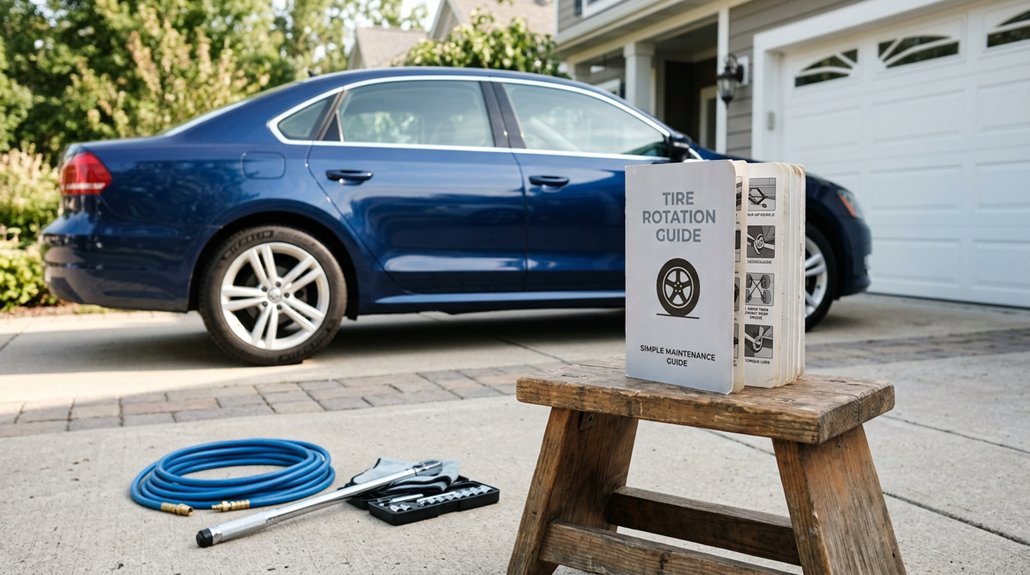
Most drivers rack up 13,500 miles yearly, yet nearly half skip tire rotations entirely, cutting tire life by 20,000 miles or more. I’ve watched uneven wear destroy $800 sets in under 30,000 miles because owners waited too long.
The 5,000 to 7,000 mile rule works for most gas vehicles, but your EV or high-torque truck demands tighter intervals. I’ll walk you through pinpointing your exact interval, choosing the right rotation pattern for your drivetrain, and spotting wear that screams for immediate attention. Stick around; your wallet’s about to thank you.
How Many Miles to Rotate Tires: Standard Intervals and Exceptions
How often should you rotate your tires? I typically follow tire rotation intervals of 5,000 to 7,000 miles, or roughly every other oil change. Your owner’s manual trumps my rule of thumb though; vehicle manufacturer guidelines vary, and some warranties demand specific timing to keep coverage intact.
I check my tread depth regularly because uneven tread wear signals trouble. When I spot it, I rotate immediately to restore balance between front and rear tires. Your drive type, FWD, RWD, or AWD, shapes how tires wear differently, though I’ll save pattern specifics for later.
Harsh conditions speed up wear. Stop-and-go traffic, heavy hauling, and rough pavement punish rubber faster. For EVs and high-torque vehicles, I tighten my window to 5,000–6,000 miles. The instant torque eats through tread otherwise.
Recommended Products
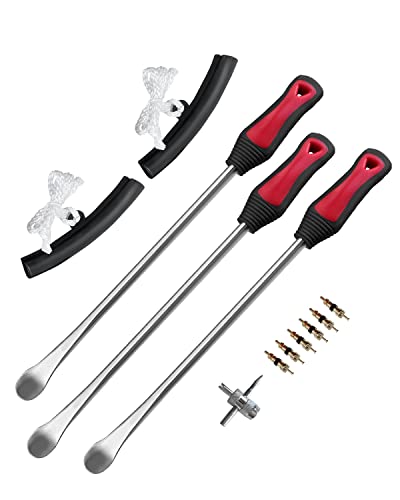
High Quality: Crafted from hardened steel-iron, each tire iron spoon features curved tips for superior strength and reliable durability. This robust construction ensures you...
Which Tire Rotation Pattern Fits Your Drivetrain?
Why does drivetrain type dictate how I swap my tires around? Because each drivetrain wears tires differently, and matching the right tire rotation pattern keeps your rubber lasting longer.
For FWD vehicles, I move the front tires straight back and cross the rear tires to the front. With RWD, I reverse that: rear tires go straight forward, front tires cross to the rear.
AWD/4WD setups usually need a crisscross pattern to balance wear across all four corners.
Directional tires change everything. I never cross-rotate them; I only swap front-to-rear on the same side, following manufacturer guidance strictly. Staggered setups with wider rear tires may not rotate at all without size changes.
If you run a full-size spare, include it in your rotation. Just remember, TPMS re-learning might be needed afterward.
What Skipping Rotations Costs Your Tires and Wallet
When exactly does neglecting a simple rotation turn into an expensive mistake? I’ve seen it happen, and it isn’t pretty. Skip your tire rotation interval, and you’ll watch uneven tread wear chew through tire life faster than you’d expect. Your drive type determines how aggressively this happens: front-wheel-drive cars wear fronts quickest, while all-wheel-drive systems stress all four corners differently.
I’ve tested enough vehicles to know that ignoring proper rotation patterns voids warranty requirements, leaving you holding the bill when premature failures strike. The maintenance costs stack up quickly: vibrations demand rebalancing, handling issues need alignment, and suddenly you’re buying new rubber years too early.
Stick to the schedule your manufacturer recommends. Your wallet, and your grip on the road, will thank you.
Recommended Products

Set of 4 New HALBERD Sport ATV Tires 21x7-10 Front & 22x10-10 Rear

Aggressive Tread Design: The rugged, block-style tread pattern delivers exceptional grip on loose gravel, mud, sand, and rocky terrain, ensuring confidence in off-road conditions.
![12.5'' x 1.75/2.25 Premium Explosion Proof Front Inner Tire Tube for All BOB Revolution Strollers, Stroller Strides & CE & AW - Perfect BOB Stroller TireTube Replacement [2 Pack] Steerling Tire Co.](https://m.media-amazon.com/images/I/41l1GFAoASL._SL500_.jpg)
12" x 1.75/2.125 Inner Tube Replacement That Fits Baby Strollers and Kids Bikes: The perfect BOB stroller front tire tube replacement for all BOB Revolution, Alterrain, Stroller Strides and Rambler, RoyalBaby, Schwinn Koen & Elm, Dynacraft, JOYSTAR and COEWSKE. Universal fit for 12" or 12.5" wheels.
Check for Rotation-Worthy Wear Before Your Next Service
Where exactly should you look to catch uneven wear before it ruins your tires? I always inspect my four tires before scheduling any tire rotation, since spotting problems early saves money and keeps me safe.
Here’s what I check during my inspection before rotation:
- Tread wear patterns across each tire, feeling for uneven wear like feathered edges or bald centers that scream for a rotation pattern swap
- Cupping or scalloping on the tread surface, which tells me my tires aren’t contacting the road evenly
- Whether all four tires match in wear depth, or if some positions are clearly working harder than others
I also scan for sidewall damage that could affect rotation feasibility. When I find issues, I consult my vehicle owner’s manual for the correct rotation pattern. Catching uneven wear early means I stay ahead of problems, not behind them.
Recommended Products

1.Accurate and Efficient: Different colors on the bar represents different scopes, the red range on bar: 0 - 3/ 32; Yellow range on bar: 3/ 32 - 6/ 32; Green range on bar: 6/ 32 - 32/ 32, allowing you easy and fast to read and calibrated

Accurate and precise tire tread depth readings in 1/32 inch increments (1/128 inch resolution)

Accurate measures tire tread depth gauge tool