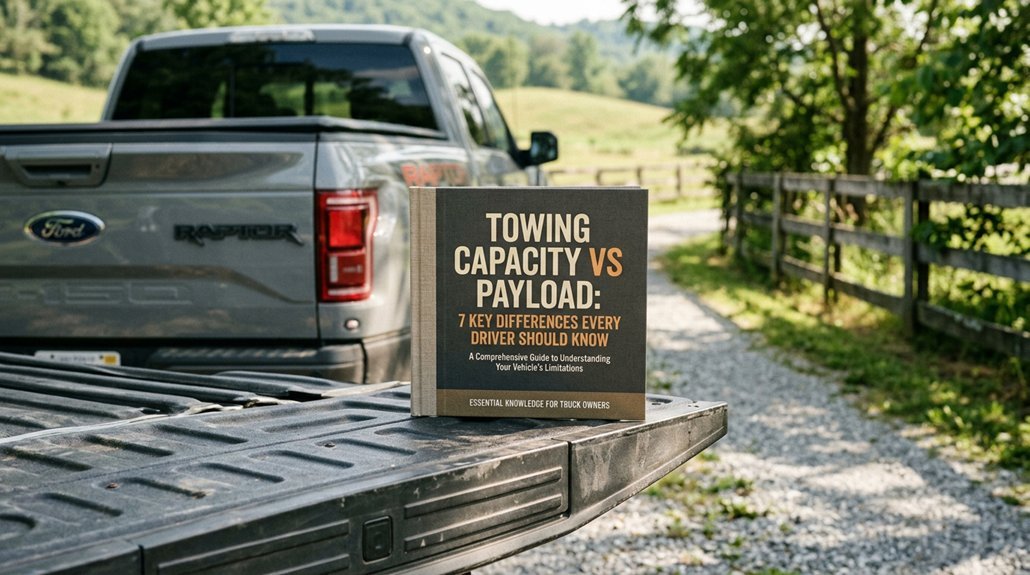
I once watched a contractor load his shiny new half-ton with two pallets of concrete blocks, then hitch up a 10,000-pound excavator, confident he’d “stay under the limits.” He made it three miles before his rear suspension folded like a cheap card table.
That day taught me payload and towing capacity aren’t interchangeable numbers on a brochure, they’re hard boundaries with real consequences. Get them wrong, and you’re not just risking fines: you’re gambling with brakes, bearings, and every driver behind you.
Here’s how they actually work, and why confusing them costs more than a repair bill.
Payload vs. Towing: What’s the Difference?
Why do so many buyers get burned mixing up payload and towing? I’ve seen it happen at campgrounds, job sites, and dealership lots. Payload is what I can haul inside my truck: tools, gear, passengers, all it. Towing capacity is what I can pull behind me on a trailer. They’re not interchangeable.
Here’s where it gets tricky. My payload equals GVWR minus curb weight, the truck’s bare weight with fluids. My towing capacity comes from GCWR minus curb weight, and it’s usually much higher. But tongue weight, that downward force from the trailer hitch, counts against my payload. A 10,000-pound trailer adds 1,000–1,500 pounds I must subtract from my bed capacity.
I always check my door jamb sticker, not guesses.
Recommended Products

PROTECTIVE HINGED COVER: Features a hinged, hard cover that protects the keys and display when stored, making this handheld calculator durable and easy to carry safely.

Powered by 4 AA batteries, power adapter not included, includes starter size paper roll
GVWR, GCWR, and Curb Weight Explained
I want you to understand three numbers that’ll keep you legal and safe when you’re hauling heavy loads. GVWR caps how much your truck can weigh fully loaded with people, gear, and fuel, while GCWR covers the combined heft of your rig plus whatever you’re towing behind it.
Curb weight gives you the baseline, your truck’s heft with fluids and a full tank but nothing else, so you can calculate what’s actually left for payload and trailer.
Recommended Products

[Quick & Easy Installation] Our trailer wheel bearing kits are designed for a hassle-free setup, saving you time and effort

WEIGHT DISTRIBUTION: Hardened steel chains connect the hitch arms to your trailer frame for improved load distribution. The result is improved steering, braking control, and helping to reduce stressful towing situations.
GVWR Safety Limits
Because I spend weekends hauling equipment to job sites and trailers to campsites, I’ve learned that respecting GVWR isn’t optional. It’s the difference between a safe trip and a blown tire or worse.
I always check my driver’s door placard first. That sticker lists my GVWR, the absolute ceiling for my truck’s loaded weight. I subtract curb weight, the rig with fluids but no gear, to find my actual payload capacity. Here’s what I track:
- GVWR caps everything inside my truck bed and cabin
- Curb weight is my baseline before I load a single tool
- Payload capacity shrinks fast with heavy accessories
- Gross combined weight includes my trailer, but that’s GCWR territory
Know your numbers, load smart, and you’ll haul with confidence.
GCWR Combined Ratings
Once you’ve nailed down your GVWR, it’s time to look at the bigger picture. GCWR, or Gross Combined Weight Rating, represents the maximum allowable combined weight of your tow vehicle plus everything you’re hauling, including the trailer load and its cargo.
I see GCWR as the ceiling that keeps your whole setup safe. It’s always higher than your GVWR because it accounts for towing stress on your frame, suspension, axles, and brakes. While GVWR governs your truck plus payload capacity when running solo, GCWR expands to cover the total package.
Here’s how I calculate safe limits: subtract your tow vehicle’s curb weight from the GCWR. This gives you the maximum combined loaded weight you can legally and safely pull. Manufacturers determine these ratings through testing, so I never exceed them.
Curb Weight Basics
Why does your truck’s empty weight matter so much? It determines everything about what you can safely haul. Curb weight is your rig’s mass with fluids, fuel, and standard equipment, no passengers or cargo. I always check my door jamb sticker first; it holds the GVWR and payload ratings for my exact configuration.
Here’s how these numbers work together:
- Curb weight plus passengers, cargo, and tongue weight must stay under GVWR
- GVWR vs GCWR: GVWR covers just your vehicle, GCWR adds your loaded trailer
- Subtract curb weight from GVWR to find your real payload capacity
- GCWR sets the hard ceiling for combined tow vehicle and trailer weight
Get these wrong and you’re risking brake fade, transmission damage, or worse. I measure twice, tow once.
How to Calculate Your Truck’s Payload Capacity
Ever wondered how much your truck can actually haul before you’re pushing its limits? I’ll walk you through finding your real payload capacity. It’s straightforward: take your GVWR and subtract your curb weight. That’s your baseline. If your GVWR hits 9,000 lb and your curb weight sits at 5,000 lb, you’re looking at 4,000 lb of payload.
But here’s where folks slip up. Tongue weight from any trailer counts against that payload, typically 10–15% of what you’re towing. Skip this, and you’ll overload your springs without realizing it.
Bed racks, tool boxes, running boards, they all nibble away at your available capacity too. For the definitive number, check your door jamb sticker or owner’s manual. Configurations vary wildly by trim and options. Don’t guess. Know your limits, and your truck stays reliable for the long haul.
How to Calculate Your Truck’s Towing Capacity
Finding your truck’s actual towing capacity isn’t guesswork, it’s simple math that could save your transmission. I subtract my curb weight from the GCWR to get my baseline, but that’s just step one.
Here’s what I always verify before hitching up:
- Locate your door jamb sticker for official GVWR and GCWR numbers, not brochure estimates
- Calculate 10–15% of your trailer weight as tongue weight, this lands on your hitch
- Check that tongue weight against remaining payload capacity after passengers and gear
- Weigh everything on scales, trailer weight shifts during loading, manufacturers assume empty configurations
Your payload capacity and GVWR create hard ceilings regardless of what the tow rating suggests. I never exceed my rear axle rating, and I recommend you verify with certified scales. Real weights expose assumptions fast.
Recommended Products

Military Standards Compliant: The Belleville Khyber TR550 tactical shoes are crafted to meet AR 670-1 and AFI 36-2903 standards, ensuring compatibility with military uniform requirements. These military boots for men provide reliability in professional settings

Kit Includes: 1x New 3rd 6-Hole 5.5" brake drum; 1x for 25580 inner cone bearing, 1x for 15123 outer cone bearing; 1x oil seal; 1x dust cover; 6x hub nut

Compatible with: For Dexter/ for Al-Ko/ for Lippert/ for Quality and other brands 7k,7,000lbs trailer axles; Only works on models for 25580 inner cone and for 14125A outer cone bearings trailer axles; Brake flange PCD: 3.88"
Why Tongue Weight Reduces Your Payload
I’ll use my firsthand experience testing trucks with trailers to show you how tongue weight eats directly into your payload capacity. That downward force from the hitch, usually 9–12% of what you’re towing, counts pound for pound against your door jamb GVWR rating.
I’ve seen plenty of owners max out their cabs with passengers and gear, only to discover their 800-pound tongue weight pushed them past legal limits. That leaves no room for error when braking distances stretch and tire wear accelerates.
Tongue Weight Defined
Tongue weight, it’s the downward force your trailer exerts on your hitch ball, usually around 10–12% of whatever you’re towing. This hitch load transfers directly onto your truck’s rear axle, becoming part of your rear-axle load whether you’re hauling a 3,000-pound utility trailer or a 10,000-pound camper.
Here’s what you need to track:
- Tongue weight counts against payload capacity, not towing capacity
- Trailer weight determines your actual tongue weight percentage
- Exceeding GVWR happens when you ignore this calculation
- Weight-distribution systems can shift load, but don’t eliminate it
I learned this the hard way loading my truck for a weekend trip. I’d calculated passengers and gear, but forgot the 800-pound tongue weight from my trailer. Suddenly my available payload shrank dramatically. Always subtract tongue weight first, then pack accordingly.
Payload Impact Illustrated
That 800-pound hitch load I mentioned isn’t just sitting on your bumper; it’s coming straight out of your payload budget. I learned this the hard way when I packed my truck for a camping trip and realized my tongue weight had already eaten half my available capacity.
Here’s the math that matters: your payload equals GVWR minus curb weight. Add tongue weight, typically 10–15% of trailer weight, and you’re subtracting from that same pool. My 1,200-pound tongue weight meant leaving gear behind or finding a stronger truck.
Trailer weight distribution helps spread the load, but don’t be fooled: that weight still counts against your payload calculations, even with a distribution hitch. I’ve seen drivers overload their rear axles while staying under gross combined weight rating, creating dangerous handling.
Get your actual tongue weight on a scale. Manufacturer specs rarely match real-world loading, and guessing risks your safety margin.
What Breaks When You Overload Your Truck
When I load my truck past its limits, I’m not just pushing numbers on a spec sheet, I’m asking every component to work harder than it was built for. I’ve learned that GVWR, payload capacity, and towing capacity aren’t suggestions, they’re hard boundaries protecting me from overload risks.
Exceeding GAWR strains my axles and deforms suspension components, especially when I miscalculate tongue weight. My transmission overheats, my brake pads glaze from fade, and my stopping distance grows dangerously long. Tire blowouts lurk when I ignore load ratings.
- Brake fade and longer stops from excessive heat on rotors and pads
- Suspension deformation and stability loss, particularly on curves or in crosswinds
- Transmission strain and engine overheating from excessive payload or tongue weight
- Accelerated tire wear and blowout risk when exceeding load ratings
I distribute weight carefully, upgrade hitches when needed, and respect every rating.
Recommended Products

【Ensuring Safe Driving】: This heavy-duty Weight distribution hitch hookup bracket effectively distributes the trailer's load across all four wheels of your towing vehicle, whether it's a car or a truck. This reduces the excessive pressure applied by the trailer to a single tire or axle, thereby extending the lifespan of both the tires and the suspension system. Enjoy a balanced ride for both your tow vehicle and trailer, making every trip smoother and safer.

Compatible with: For Dexter/ for Al-Ko/ for Lippert/ for Quality and other brands 3,500lbs trailer axles; Only works on models for L68149 inner cone and replacement for L44649 outer cone bearings trailer axles, Only fits 1-1/16 to1-3/8 spindle axle. Brake flange PCD: 4". (Note: Not compatible with the 4400lbs axle)

Balanced Braking Force: The trailer brake adjusters can adjust the braking force of the trailer by connecting to the vehicle's braking system. The trailer brake adjuster controls friction on trailer tires and evenly distributes the braking force across all wheels, maintaining vehicle stability during stops and reducing wear on specific tires.
Where to Find Your Truck’s Exact Weight Ratings
Where exactly do I find the numbers that keep my truck safe? I always start with the door jamb sticker on the driver’s side. That label lists my GVWR, the maximum loaded weight my truck can handle.
I cross-check this with my owner’s manual, which breaks down every rating I need. My curb weight, the truck with fluids but no cargo, lives there too. I subtract that from my GVWR to find my payload capacity, the real limit for passengers and gear.
For towing, I hunt down my GCWR, the combined maximum for truck and trailer. I never guess or rely on memory. These factory numbers protect my investment, my safety, and everyone sharing the road with me.