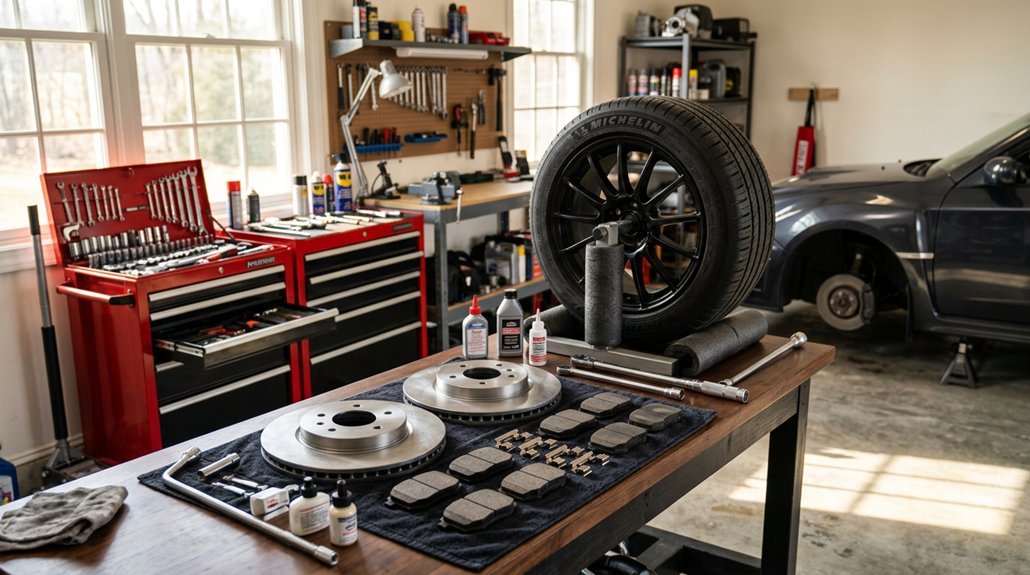
The clock on my garage wall doesn’t lie; it measures patience, not just hours. I’ve swapped pads in 30 minutes when everything cooperates, and I’ve fought seized bolts until sunset. Most DIYers finish one axle in 1 to 3 hours, and shops often match that. But rust, high-end calipers, or electronic parking brakes can hijack your whole afternoon. Your timeline depends on what you’re driving, where you live, and whether Murphy’s Law shows up. Let me walk you through what actually slows you down.
Brake Pad and Rotor Replacement: How Long Does It Take?
How long should you really expect to spend swapping out your brake pads and rotors? I’ve done this enough times to know that rotor replacement and brake pad installation typically take 1 to 3 hours per axle.
Time estimates aren’t one-size-fits-all, though. Luxury and high-performance cars often throw you curveballs with intricate parts that demand extra attention. You’ll want to factor in your specific vehicle make when planning your afternoon.
Calipers complicate things. If they need bleeding, add 1 to 2 hours for proper fluid filling and air removal. I’ve learned this the hard way on weekend projects.
A full brake system overhaul, pads, rotors, and calipers together, runs 3+ hours minimum. Testing and final adjustments tack on another 20 to 30 minutes. Plan accordingly, and you’ll finish with brakes you actually trust.
Recommended Products

Kit Includes: 1 Front Ceramic Brake Pad Set; 2 Front Brake Rotors

Kit Includes: 1 Rear Ceramic Brake Pad Set; 2 Rear Brake Rotors

【4 Pairs Balanced Semi-Metallic Compound】Engineered from a semi-metallic compound, these disc brake pads strike an optimal balance between braking response, heat dissipation, wear resistance, and noise suppression. Ideal for everyday mountain trails, city commuting, and recreational rides.
DIY or Professional Brake Service: Which Saves More Time?
Knowing how long brake work takes on paper is one thing, deciding who should actually turn the wrenches is where things get interesting. I’ve weighed DIY vs professional carefully, and brake service time really hinges on your setup and skill level.
The metallic scrape of worn pads against rotors echoing through your garage. Brake fluid pooling beneath a stubborn caliper during a botched bleeding attempt. A pro shop’s air tools screaming through all four corners in one afternoon.
I can swap pads in 30 minutes per corner when everything cooperates, but caliper bleeding time stretches that fast. Rotors add another hour each. Shops complete full overhauls in 3+ hours because they’ve done it hundreds of times. For complex jobs, professionals save time, every time.
Recommended Products

COMPREHENSIVE SET: Get the ultimate brake maintenance experience with Orion Motor Tech's comprehensive brake tool set, allowing you to tackle any brake pad replacement and brake bleeding task with ease

UNIVERSAL BLEEDING KIT: Orion Motor Tech's brake bleeding vacuum pump with an adapter set works with nearly any vehicle's system and lets you bleed your brakes, clutch, or any other vehicular hydraulic system in under 5 minutes all by yourself
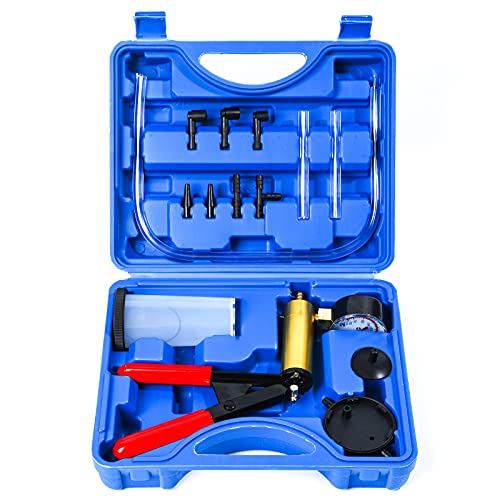
Versatile: Brake bleeder kit comes with a vacuum gauge to help you take accurate readings. Pressure range: 0-30 inches Hg, 0-760 mmHg. It includes accessories for brake bleeding and automotive diagnostics.
What Slows Down Brake Repairs: Vehicle Type and Rust Damage
Where does your afternoon go when brake service drags on? I’ve watched brake repair time stretch from a quick hour to a full day, and two culprits usually deserve the blame: vehicle type and rust damage.
Your vehicle type sets the baseline. Standard cars, trucks, and SUVs typically run 30 minutes to 2 hours per corner for pads and rotors. But luxury or high-performance machines? Their specialized braking systems demand intricate disassembly, scarce parts, and precise reassembly. I’ve seen German and Italian hardware turn simple jobs into half-day affairs.
Vehicle type sets your baseline—standard rides take an hour per corner, but luxury hardware turns simple jobs into half-day affairs.
Then there’s rust damage, especially if you drive in the rust belt. Corroded rotors, frozen calipers, and seized backing plates can balloon estimates toward 10 hours. E-brake systems are particularly vulnerable, often requiring extra steps to free or replace components.
Factor in caliper replacement or rotor resurfacing, and you’re looking at 3+ hours minimum.
Recommended Products

⏭️Drum Brake Shoe Set Compatible With: (Please comfirm fitment with the amazoncomfirmedfit!) Replacement Rear Brake Shoes for 2005 - 2008 Chevrolet GMC Silverado Sierra 1500

Mini bike brake shoes replacement for 6.5Hp 196cc MB165 MB200 BT200X CT200U motorsports mini bike CRF70 TaoTao GY6 49cc 50cc scooter moped atv

Drum Brake Shoe Set Compatible With: (Please comfirm fitment with the amazoncomfirmedfit!) Replacement Rear Brake Shoes for 2005-2021 Toyota Tacoma modeles
Step-by-Step Brake Replacement: From Inspection to Test Drive
Why does one brake job take an hour while another eats half your day? I’ve learned it comes down to knowing exactly what you’re walking into, and I’ll walk you through my process.
My brake inspection runs 15–30 minutes: I pull wheels, measure pad thickness, check rotor wear patterns, and spot seized hardware before touching a wrench. This diagnosis saves you from mid-repair surprises.
The brake replacement itself spans 30 minutes to 3 hours depending on what I find. A straightforward pad swap moves fast; caliper replacements require bleeding and extend timelines significantly.
- A micrometer revealing paper-thin rotors glowing under my shop light
- Brake fluid pushing through clear tubing, air bubbles streaking upward like tiny failures escaping
- Fresh pads biting cold rotors during that first careful test drive
Post-repair verification demands 20–30 minutes. I bed components, confirm pedal feel, and road-test before handing keys back. A full system overhaul: 3+ hours, extensive testing mandatory.
Recommended Products
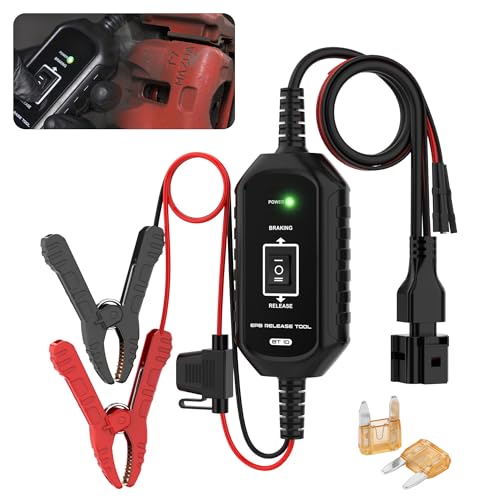
1.【Emergency EPB Release and Reset】 - Whether your vehicle has a dead battery, system failure, or requires maintenance, the Electronic Parking Brake Tool allows you to quickly, intelligently, and safely release or reset the brake. This enables you to move the vehicle and perform secure brake service and maintenance.

【Intelligent Dual-Control System】Its electronic parking brake emergency drive system with a core processor enables bidirectional control of forward and reverse rotation, capable of both releasing and applying the electronic parking brake. This rapidly resolves Electronic Parking Brake (EPB) malfunctions.

【Emergency EPB Release & Reset Tool】Quickly resolve electronic parking brake (EPB) failures with dual-channel control for precise release and braking functions. Ideal for roadside emergencies, garage maintenance, and safe vehicle movement during power loss or system errors
Why Your Brake Job Might Take Longer Than Expected
How often have you budgeted an hour for brakes only to lose your afternoon to rusted bolts and seized calipers? I have, and it stings every time.
Labor time estimates assume smooth sailing. They do not account for what you actually find under there. When I encounter a seized caliper, I am looking at another one to two hours minimum, bleeding and filling the brake system properly.
Living in the rust belt, I have seen jobs stretch past ten hours or spill into tomorrow morning. Hidden issues multiply fast. A simple pad swap becomes a full brake system overhaul when rotors are warped, hardware is fused, and the e-brake cables have fused to their housings. You cannot see it coming.
Familiarity helps, but rust does not negotiate. Budget extra time, or prepare to walk away disappointed.
Recommended Products

Versatile Tool: This brake drum and rotor removal bolt set is designed for removing brake drums and rotors with ease.

EFFECTIVE RUST REMOVAL PERFORMANCE: This wheel hub resurfacing kit comes with 6 cleaning pads, designed to remove rust, corrosion and stubborn grime from lug studs, wheel hubs and brake rotors. It cleans thoroughly while protecting the underlying metal surfaces from scratches, suitable for daily maintenance and rust restoration needs.

OTC's 6980 HD Brake Drum and Rotor puller is American made and is designed to handle large components such as brake drums, rotors, drive wheels, gears, flywheels, and pulleys