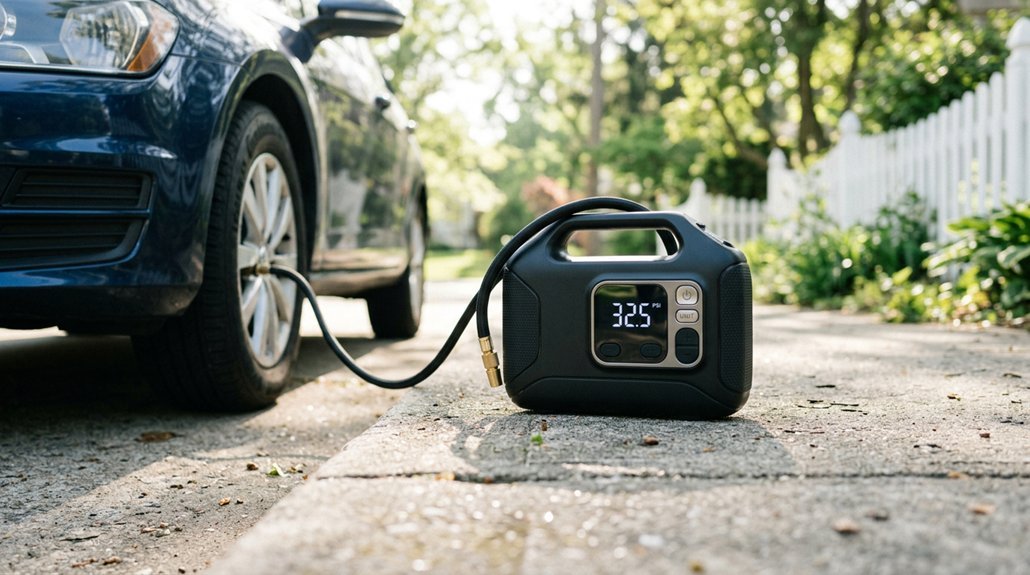
Most drivers never check their spare tire pressure, and that oversight can leave you stranded when you need it most. I’ll walk you through the five steps I use to keep all five tires properly inflated, from finding your door sticker’s cold PSI rating to using a calibrated personal gauge instead of trusting sketchy station equipment.
You’ll learn why waiting three hours after driving matters, how short bursts prevent overinflation, and the monthly habit that catches slow leaks before they strand you.
Find Your Recommended Tire Pressure on the Door Sticker
Where exactly should you look when your tires need air? I’ll show you exactly where to find your numbers. Open your driver’s door and check the door pillar, that’s where the door sticker lives. Most drivers miss this completely.
Check your driver’s door pillar—most drivers completely miss the sticker with your exact tire pressure numbers hiding right there.
Your door sticker lists cold pressure values separately for front and rear tires. These aren’t suggestions; they’re your recommended PSI from the manufacturer. I always photograph mine for quick reference.
Can’t locate the sticker? Check your door jamb thoroughly, or grab your owner’s manual. The manual contains identical tire pressure specifications.
Here’s what trips people up: never use the sidewall pressure. That number shows maximum safe inflation, not your target. Your sticker’s cold pressure accounts for your specific vehicle weight and handling characteristics.
For proper tire inflation, I follow my door sticker religiously. It’s engineered for my exact model, not generic guesses.
Recommended Products
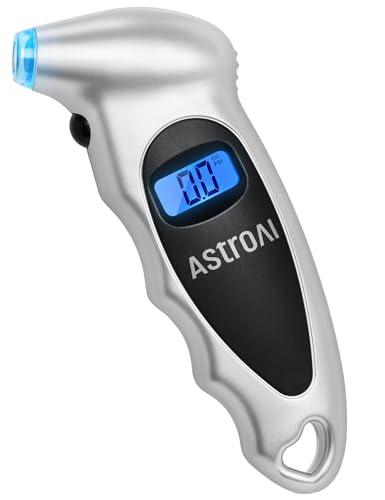
Accurate, Dependable Readings: Factory‑calibrated to ±1 PSI, so you can confidently match your vehicle’s recommended PSI (check the door jamb sticker). Ideal for monthly checks and road trips — consistent results every time, cold or warm.

PROCESS LEVEL ACCURACY: Each ETENWOLF’s digital tire pressure gauge is calibrated manually to ANSI B40.7 Grade 2A(plus-minus 1 PSI).Presta valve adapter not included, if used for bicycles, it must be purchased separately

HIGH ACCURACY: Every ETENWOLF's pencil tire gauge is calibrated to ANSI B40.1 Grade B, it is accurate to 2% of span in the middle 50% of range and 3% of span in the lower and upper 25% of range. Each ETENWOLF pencil tire pressure gauge is manually calibrated and has its unique calibration number printed on the pencil
Check Tires When Cold: Wait 3 Hours After Driving
Why does timing matter so much when checking tire pressure? I’ve learned that cold readings give you the real picture. When tires are cold, meaning you haven’t driven for at least two to three hours, the air pressure sits at its true baseline. Drive even a few miles, and friction heats things up. That warmth expands the air inside, inflating your reading by several psi.
I always wait 3 hours before I check and inflate. The NHTSA recommends this approach because warm-tire readings mislead you into underinflating by accident. Tires naturally lose about 1.45 psi monthly, so accurate cold checks help spot actual leaks versus normal seepage.
Grab your own calibrated pressure gauge. Station gauges often read high or low, and I’ve found personal verification essential. Trust your cold-target numbers, not the warm-tire illusion.
Recommended Products

ADVANCED TRUEGAUGE SCREEN: This battery tire inflator includes updated sensor technology, capable of collecting pressure data from tire inflators at a frequency of 200 times per second. Its valid data rate is higher than 80%, which is 60% better than the market average. From routine maintenance to roadside emergencies, its accurate readings ensure confident pressure checks and a safer driving experience.Suitable as a Father's Day gift for your dad.
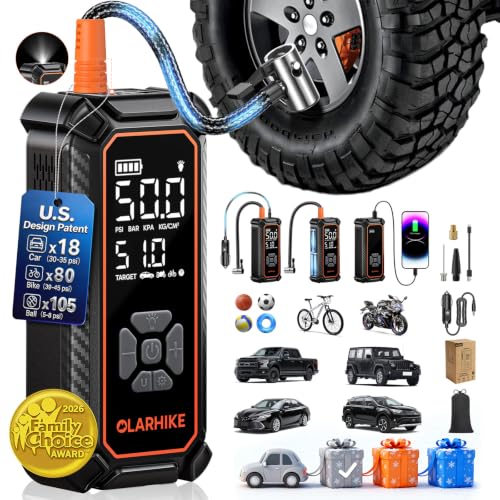
[Fast & Efficient Inflation] The OlarHike tire inflator features a high-performance motor that delivers rapid airflow—inflate a standard car tire (195/65 R15) from 30 to 35 PSI (+5 PSI) in just 55 seconds, or a larger SUV tire (235/65 R17) from 30 to 35 PSI (+5 PSI) in only 2.2 minutes. Ideal for cars, SUVs, light Pickup(Within 51 PSI), motorcycles, bicycles, and sports balls. Its practical everyday usefulness also makes it a thoughtful car gift for men who value reliable tools for their vehicles. Important Note: The unit can only inflate car and pickup truck tires up to 51 PSI and is not compatible with heavy-duty pickup trucks or RVs.

RAPID INFLATION & ROAD-READY PORTABILITY: Powerful 120W motor delivers up to 35L/min airflow—inflates a standard car tire (195/65 R15) from 30 to 36 PSI in under 1 minute under ideal operating conditions. Weighs only 2.2 lbs and fits glove compartments or trunks for daily commutes, road trips, and emergencies. Plugs into standard 12V DC car outlet with 15A fuse protection. AIRUN H features its cordless counterpart H2 Pro.
Add Air in Short Bursts to Avoid Overinflation
How do you avoid the frustration of overinflated tires? I add air in short bursts, never holding the trigger down for more than a second or two. This prevents overshooting your target pressure, which happens faster than you’d expect with high-volume station pumps.
After each burst, I pause to let the tire and gauge settle. Then I recheck pressure before adding more. I inflate conservatively, stopping slightly below my target pressure. If I’m close, I verify with my own calibrated gauge, since built-in pump gauges can read off by several PSI.
I always account for tire cool-down. Warm tires read higher due to air expansion, so I factor this in when inflating after driving. Taking these measured steps keeps me in the sweet spot, avoiding the hassle of bleeding off excess air.
Recommended Products
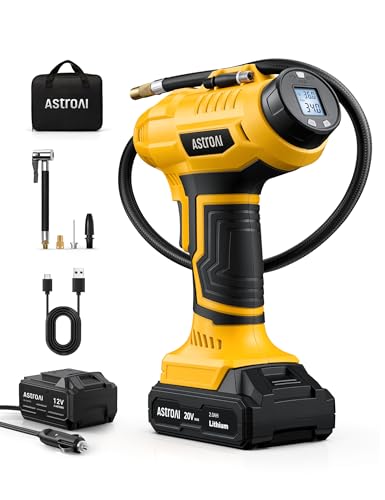
【FAST 160 PSI INFLATION WITH DURABLE METAL CONSTRUCTION】This tire inflator portable air compressor delivers up to 160 PSI maximum pressure.Under typical testing conditions, it can inflate a standard car tire from 30 to 36 PSI in under 40 seconds and inflate a 195/65/R15 tire in about 4 minutes. Built with a durable metal cylinder and gear system, it supports up to 20 minutes of continuous operation for reliable daily tire maintenance and roadside emergencies.

Fast & Powerful Pump: This mini inflator offers rapid inflation with a maximum pressure of 150 PSI. It can inflate a 195/65 R15 tire from 30 to 36 PSI in under 1 minute, and easily meets your daily needs for bike, car, and motorcycle inflation.

Fast Inflation & Easy Operation: The air pump’s high-quality cylinder delivers 25L/Min inflation, filling a tire from 29 PSI to 36 PSI in just one minute. Easy operation, quick inflation. Please note that you should allow the air compressor to cool off for a while after 15 minutes of continuous operation. (NOTE: This tire inflator can only be used if connected to a 12 V DC, 15 A cigarette lighter). NO AC!
Verify the Final PSI With Your Own Gauge
Once I’ve finished inflating in short bursts, I grab my own tire pressure gauge to verify the final PSI. I don’t trust gas station gauges; they’re often off by 2-3 PSI, which defeats the whole inflation process. I’ve learned to check cold tires, ideally at dawn, since heat from driving skews readings.
Here’s what I do to nail the reading:
- Press the gauge firmly onto the valve stem, hearing that satisfying hiss of contact
- Watch the dial or digital display settle, comparing it to my door jamb sticker
- Repeat on all four tires, plus the spare tire hiding in my trunk
- Adjust in short bursts if I’m still below manufacturer recommended PSI
If I inflated warm tires, I wait 30 minutes and recheck. Getting low tire pressure right means safer handling, better mileage, and tires that last.
Recommended Products

High quality vinyl stickers. Professionally made in the USA.

High quality vinyl stickers. Professionally made in the USA.

High quality vinyl stickers. Professionally made in the USA.
Recheck Monthly and Before Road Trips
Where does that 1 PSI per month go? Tires naturally lose pressure through the rubber, and I don’t want you caught off guard. That’s why I check monthly, using my own tire gauge for accuracy. I remove the valve caps, test all four tires plus the spare, and compare cold readings to the door-sticker pressures.
Before road trips, I recheck everything. Extra miles mean extra heat, and I verify my cold readings match the manufacturer’s recommended PSI. If temperatures dropped recently, I anticipate losing 1–2 PSI per 10°F and retest after the tires cool. I never trust station gauges alone; I verify with my calibrated tire gauge, then recheck once cooled.
This routine keeps my tire pressure dialed in, trip after trip.
Recommended Products

ETENWOLF T300 Plus Tire Pressure Gauge 200 PSI, Digital Tire Gauge with Bright LED Display, Tire Gauges for Tire Pressure

Wide Range: This tire pressure gauge features a 3-300PSI range and highly accurate ANSI B40.7 2A measurements. It is compatible with most vehicles, including cars, trucks, SUVs, motorcycles. It also provides 4 pressure units to choose from, PSI, bar, kPa, kg/cm².

Align the pressure tap with the tire, and then squeeze it hard to keep the air tight. The tire pressure gauge will automatically display the reading.