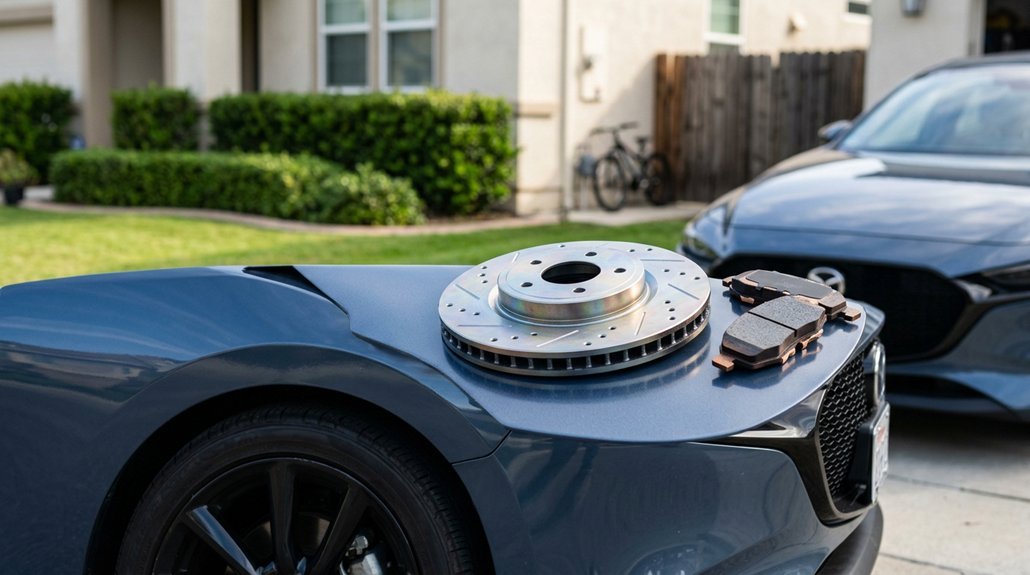
I have priced brake jobs across dozens of shops and the spread still surprises me.
A basic front pad swap runs $195–$300 per axle at independent shops, while full pad-and-rotor service on both axles hits $850–$1,400.
Labor clocks 1–2 hours per axle at $90–$200 hourly, and ceramic pads add 30–50% for quieter stops.
Dealerships consistently quote higher, sometimes by 40%, for identical parts.
The real cost driver is not where you go; it is what your rotors actually need.
What New Brakes Cost in 2024: Price Ranges by Vehicle Type
How much should you actually expect to pay when your brakes start squealing? I’ve found brake pads with parts and labor typically run $195–$300 per axle for front or rear, or $390–$600 total if you’re doing both axles with pads only. Need rotors too? That pushes front or rear jobs to $425–$700 per axle, with full four-wheel pad and rotor replacement hitting $850–$1,400.
Your vehicle type matters more than you’d think. European models, BMW and Mercedes especially, have higher prices for both parts and specialized labor. Domestic trucks and Japanese sedans usually land on the lower end. I’ve watched quotes swing wildly based on rotor condition, pad material choice, ceramic versus semi-metallic, and shop overhead. Always get multiple estimates before committing.
Recommended Products

PLEASE CONFIRM YOUR FITMENT: Using the Amazon Confirmed Fit bar at the top of the page or check the Product Description to confirm your vehicle fitment. This may be delivered in multiple boxes
PLEASE CONFIRM YOUR FITMENT: Using the Amazon Confirmed Fit bar at the top of the page or check the Product Description to confirm your vehicle fitment. This may be delivered in multiple boxes
PLEASE CONFIRM YOUR FITMENT: Using the Amazon Confirmed Fit bar at the top of the page or check the Product Description to confirm your vehicle fitment. This may be delivered in multiple boxes
Why One Brake Job Costs $200 and Another Costs $800
Why does my neighbor pay $215 for brakes while my quote hits $785 for the same kind of vehicle? I’ve learned it comes down to what’s actually getting fixed, and where.
Labor rates swing wildly, from $90 to $200 per hour, and shops need one to two hours per axle. That alone can double your bill.
Then there’s parts: my neighbor needed only pads, while my rotors were warped and needed replacement. Pad-and-rotor jobs run $425–$700, pad-only just $195–$300.
Material choices matter too. Ceramic pads cost more than semi-metallic, and severe duty driving demands tougher components. Fluid flushes, caliper swaps, these extras add up fast. Your vehicle type, manufacturer specs, and how you drive all push that final number higher or lower.
Recommended Products

[THE BOSCH ADVANTAGE] - The Bosch QuietCast line draws on over 77 years of OE braking excellence; promising the highest quality performance, industry-leading strength and durability, and exclusive innovations including Molded Shim Technology (MST)

[THE BOSCH ADVANTAGE] - The Bosch QuietCast line draws on over 77 years of OE braking excellence; promising the highest quality performance, industry-leading strength and durability, and exclusive innovations including Molded Shim Technology (MST)

[THE BOSCH ADVANTAGE] - The Bosch QuietCast line draws on over 77 years of OE braking excellence; promising the highest quality performance, industry-leading strength and durability, and exclusive innovations including Molded Shim Technology (MST)
Dealership vs. Independent Shop: Who Charges More for Brakes
Where you take your vehicle matters just as much as what’s wrong with it. I’ve found that dealerships consistently charge more for brake repair than independent shops, and here’s exactly why:
- Dealerships post higher labor rates, typically $120–$180 per hour
- OEM parts carry markup that independents avoid with quality aftermarket options
- Per-axle pad jobs run $195–$300 at independents, versus $350–$500+ at dealers
- Full front and rear jobs: $850–$1,400 range, with dealers clustering at the top
Rotor replacements widen this gap further. Dealerships stick with factory pricing, while independents source comparable rotors for less. I’ve saved $200–$400 comparing quotes on identical brake repair work.
Get three written estimates, demand itemized parts and labor breakdowns, and you’ll spot who’s padding their margins.
Recommended Products

Compatibility:Fit for Cadillac Escalade/ESV 07-20, Escalade EXT 07-13, XTS 13-19, Chevy Avalanche 07-13 (Except Base models) , Express 1500 09-14, for Silverado 1500 05-18, for Suburban 15-20 (Except 6.0L models), Suburban 1500 07-14 (Except Base models), for Tahoe 07-20(Except Base models)
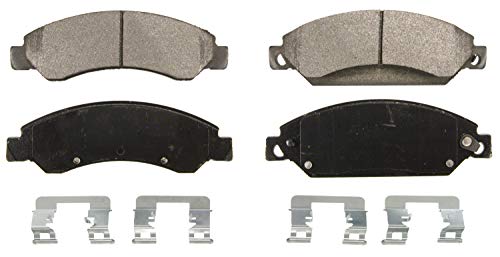
BUILT TOUGH -- Engineered for fleets and vehicles driven in demanding conditions
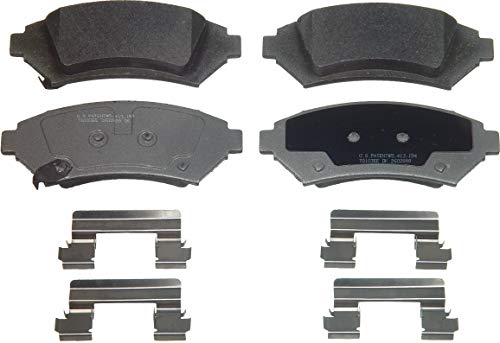
QUIET PERFORMANCE -- Semi-metallic friction material engineered in-house to allow quiet operation and high performance
Ceramic vs. Semi-Metallic Pads: How Material Affects Your Total
I’ve tested both ceramic and semi-metallic pads on daily drivers and performance builds, so I can tell you upfront that your material choice swings the total cost more than most shoppers expect. Ceramic pads run quieter and cleaner, but you’ll pay roughly 30-50% more upfront while trading some heat tolerance and initial bite compared to semi-metallic compounds.
Semi-metallic options cost less at the counter and grip harder when loaded, though they chew rotors faster and leave that familiar dark dust on your wheels.
Recommended Products

Complete Tool Set: Orion Motor Tech's 24-piece brake caliper compression tool set includes 2 retaining plates, 2 thrust bolt assemblies, 2 brake caliper hangers, and 18 adapters, easily servicing your brakes without damage

High Compatibility:This brake caliper pin bushing kit is compatible with Honda Civic 2001-2023, Chevy Malibu 2004-2012, Pontiac G5 2007-2010, and many other vehicles. The caliper slide pin boots and sealing rings help restore proper caliper operation and are ideal for brake caliper rebuild kit and brake caliper repair kit applications. Please verify your vehicle specifications before ordering.

Direct replacement - this disc brake caliper repair kit is designed to match the original components required to repair the caliper and restore proper operation of disc brakes on specified vehicles
Material Cost Differences
How much does pad material really change what you’ll pay? I’ve learned it changes plenty, and it shapes your whole ownership experience.
Here’s what I’ve found matters most:
- Ceramic pads run $30-70 per axle more than semi-metallic at purchase
- Severe duty formulations add 20-40% over standard pads but stretch replacement intervals
- Higher labor often hits with semi-metallic jobs, since faster rotor wear means turning or replacing rotors sooner
- Hidden compatibility costs emerge when your driving demands don’t match the pad you picked
I always check my manufacturer’s specs first. Mismatched materials create uneven wear patterns that drain your wallet faster than the upfront price difference ever could.
The smart move? Factor in rotor life, not just pad price, when you’re standing at the parts counter deciding where you belong.
Performance Trade-offs
Ceramic and semi-metallic pads each bring real trade-offs that hit your wallet differently over time.
I’ve tested both materials across multiple driving conditions. Ceramic pads run quiet and drop less dust on my wheels, keeping that clean look we all want. However, they can wear out faster under heavy loads or aggressive stopping. Semi-metallic pads grab harder and handle heat better during mountain descents, but I notice more noise, dust, and faster rotor wear.
High-carbon severe-duty pads last longer, yet cost more upfront. I always match materials to manufacturer specs. This protects performance and longevity.
Your true cost includes pad price plus rotor replacement frequency, cleaning time, and maintenance intervals. Choose ceramic for daily comfort, semi-metallic for demanding use, or severe-duty for maximum lifespan.
Add-Ons That Inflate Your Brake Replacement Bill
I’ve seen shops push rotor replacements when a simple resurface would’ve worked fine, and they love tacking on brake fluid flushes your owner’s manual doesn’t even call for yet. These upsells can easily add $200 to $400 to your bill without improving stopping power one bit.
I’ll show you how to spot which add-ons are legit and which ones just pad the shop’s profit margin.
Recommended Products

Specifications: The Brake Bleeder bottles can simply drain old brake fluid, rubber joints fit most bleeding screws, 60 cm (24 in) hose and chain with hooks to hold in place while collecting old brake fluid

Complete Kit: The brake system bleeding tools contain 2*6.02" long inlet hose, 2*13.77" long outlet hose, 2*check valve, 4*0.24" ID small clamps, 2*0.31" ID large clamps, 6*bleeder screw caps. Fit for hydraulic brakes on most motorcycles, cars, and bikes
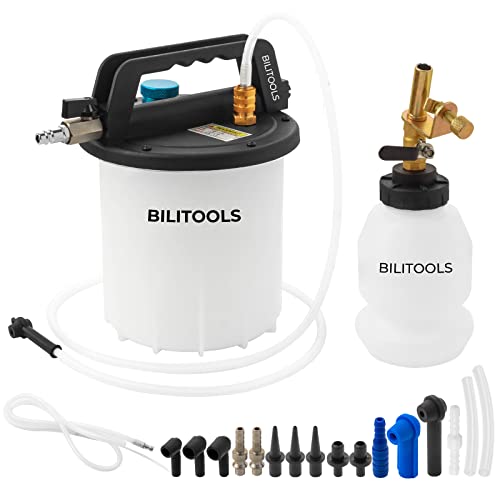
【One-Person Brake Bleeding Made Easy】 Connects to air compressor to let you bleed brakes or clutch lines on your own—no need for a helper or repeated pedal pumping. Operates at 70–170 PSI (4.8–11.6 bar) for stable, professional results.
Unnecessary Rotor Replacements
Why do so many brake jobs end up costing way more than they should? I’ve watched shops push rotor replacements that simply aren’t needed, and it burns me every time. Rotors don’t automatically need swapping just because you’re getting new pads.
Here’s what I’ve learned to watch for:
- Insist they measure rotor thickness, and don’t accept “they look worn” as an answer.
- Ask for manufacturer specs; if rotors meet minimum thickness and aren’t warped, they can stay.
- Recognize that aftermarket rotors run $30 to $75 each, plus labor per axle, so unnecessary replacements stack up fast.
- Push back on default “inspection” results that recommend replacement without documented measurements.
I’ve saved hundreds by questioning these upsells. Your shop should prove rotors are out of spec, not assume it.
Fluid Flush Upsells
How do shops turn a straightforward brake job into a $400 surprise? I’ve watched it happen: you walk in for pads and rotors, and walk out with a bill padded by a brake fluid flush upsell and extras you never requested.
A standard brake job covers pads and rotors, maybe $150–$300 per axle. Add the fluid flush, and you’re dropping another $50–$150. Shops may pitch synthetic lubricant, corrosion treatment, or caliper resurfacing too.
Here’s the reality: brake fluid replacement helps extend caliper life, but it isn’t always urgent when you’re just doing pads.
I always demand an itemized quote. I ask directly, is this fluid flush required, beneficial, or optional for my vehicle’s actual condition? Protect your wallet. Know what’s necessary before you sign.
How to Read a Brake Quote Like a Mechanic
Walking into a shop with a brake quote in hand can feel like decoding a foreign language if you don’t know what to look for. I’ve learned that brakes cost anywhere from $195 to $300 per axle for pads alone, or $425 to $700 if rotors need replacing too.
Here’s how I cut through the noise:
- Ask if rotors are worn or still within manufacturer specs
- Confirm exactly what pad material you’re getting, cheap or high-quality
- Request a clean breakdown separating parts from labor charges
- Verify everything aligns with your vehicle’s specific recommendations
Regional labor rates and shop overhead swing prices wildly, so I always compare two quotes minimum. Don’t let upsells pressure you. Know your numbers, trust your gut, and you’ll drive out confident you paid fair for safe stopping power.
Recommended Products
PLEASE CONFIRM YOUR FITMENT: Using the Amazon Confirmed Fit bar at the top of the page or check the Product Description to confirm your vehicle fitment. This may be delivered in multiple boxes

PLEASE CONFIRM YOUR FITMENT: Using the Amazon Confirmed Fit bar at the top of the page or check the Product Description to confirm your vehicle fitment. This may be delivered in multiple boxes
PLEASE CONFIRM YOUR FITMENT: Using the Amazon Confirmed Fit bar at the top of the page or check the Product Description to confirm your vehicle fitment. This may be delivered in multiple boxes