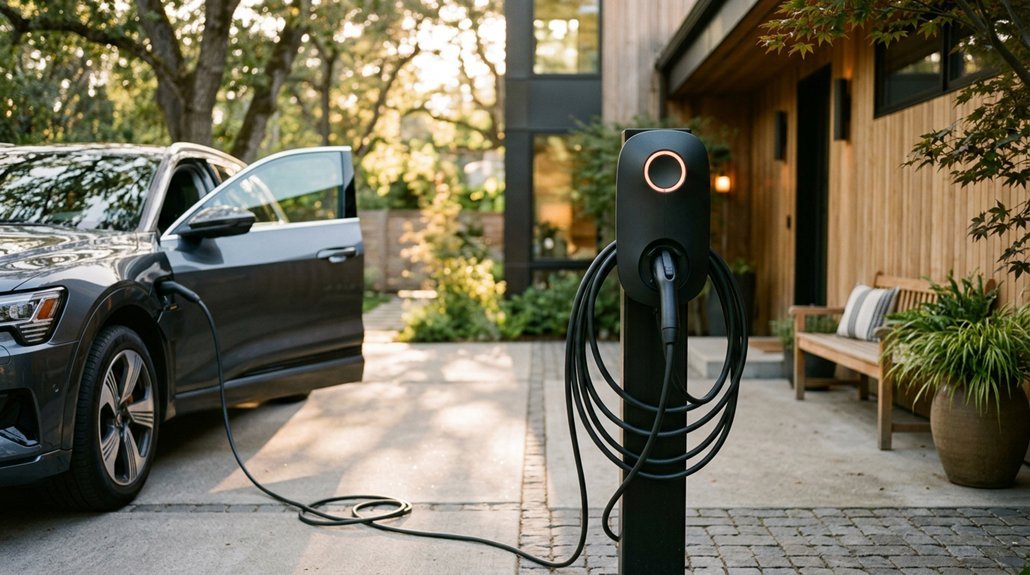
I once timed a 60 kWh battery filling from 10% to 80% on a 150 kW charger: 34 minutes flat. That same car needs 8 hours on my home Level 2 unit, or nearly a full day on standard wall power.
Your real-world time hinges on three things you can’t always control.
DC Fast Charging: How Fast Can You Really Charge an Electric Car?
How quickly can you actually get back on the road? DC fast charging provides the speed you’re looking for, but there’s a catch. I’ve watched charging speed drop noticeably as the battery approaches 80% charge, making that 10% to 80% window your sweet spot.
Your charging time depends on battery size, state of charge (SoC), and your vehicle’s maximum charging rate. A 60 kWh battery typically takes 20–60 minutes on a 50–150 kW charger. I’ve seen preconditioning and battery thermal management shave serious minutes off in cold weather by keeping everything optimal.
Not all cars play equally, either. While a Lucid Gravity accepts up to 400 kW, a Nissan Leaf caps at 150 kW regardless of station capability. Match your kW charger to your actual hardware, or you’re leaving speed on the table.
Recommended Products

⚡ Fast, Flexible Charging You Control- Equipped with a NEMA 14-50 plug and adjustable current (10A to 40A), the EVDANCE EV Charger gives you total control over your charging speed. Whether you're topping off at work or doing an overnight charge at home, simply tap the control button to select your ideal amperage. It’s precision charging, made easy NOTE: It is necessary to use a J1772 to Tesla adapter(not including) when charging your Tesla vehicles

✅【Fast & Adjustable Charging Power – Up to 7.68kWh, 16A–32A Output】This Level 2 portable EV charger delivers up to 32A and 7.68kWh for fast, efficient charging. Easily adjust current based on your home circuit: 32A for 40A, 24A for 30A, or 16A for 20A breakers. Simply long-press the “A” button to change amperage when pluged in,You can easily adjust the current (16A/24A/32A) to match your home circuit — no electrician required.

Charge with Confidence: ChargePoint builds reliable, flexible EV charging stations for home, business, and fleets. Get 24/7 support and access to hundreds of thousands of North American charging locations.
Home Charging Reality: Level 1 vs. Level 2 Times
Where do most people actually charge their EVs? At home, and I’ve learned that your choice between Level 1 charging and Level 2 charging completely changes your daily reality.
I’ve tested both, and here’s the deal. Level 1 charging uses standard 120V outlets, giving you painfully slow charge times, typically 12–20+ hours for a full fill. I’ve seen friends struggle with depleted batteries after weekend trips.
Level 2 charging transforms home charging. A 7.4 kW setup fills a 60 kWh battery in about eight hours, perfect for overnight charging.
Your charge time depends on three things: your battery capacity, your onboard charger’s limits, and your charger power. Upgrading to 240V isn’t just faster, it’s practical, energy-efficient, and exactly what most EV owners need for daily peace of mind.
Recommended Products

PD (65W) FAST CHARGING: 65W thick copper core is selected, which has the advantages of low consumption, stable and charging, and no need to wait for a long time.

【Ultra-Fast 250kW DC Fast Charging】 Supports max 250kW peak DC power fully matching Tesla V3 & V4 Supercharger output, drastically cutting highway charging downtime. Stable high-current delivery lets you gain enough driving range during short road trip stops.
![MUETUX Upgraded for Tesla Supercharger to CCS1 Charging Adapter Max [500A 1000V] Fast Charge NACS to CCS Adapter Compatible with Tesla Supercharger](https://m.media-amazon.com/images/I/41LN+vZzRZL._SL500_.jpg)
NACS to CCS1 Adapter for Tesla Supercharger V3/V4 — Works with a wide range of electric vehicles, including Ford (F-150 Lightning, Mustang Mach-E, E-Transit), GM (Chevrolet Bolt EV/EUV, Cadillac Lyriq, GMC), Rivian R1T/R1S, Hyundai Ioniq 5/Ioniq 6, Kia EV6/EV9, Volvo (XC40 Recharge, C40 Recharge, EX30, EX90), Polestar (Polestar 2, 3, 4), Lucid Air/Gravity, Nissan Ariya, and Honda Prologue. (Not compatible with Tesla vehicles or AC charging.)
7 Things That Speed Up or Slow Your EV Charge
Why does your EV charge lightning-fast one day and crawl the next? I’ve tested enough chargers to know EV charging speed isn’t fixed; it’s a negotiation between your car and the plug.
EV charging speed isn’t fixed; it’s a negotiation between your car and the plug.
Your charging rate hits two ceilings: what your battery accepts and what the charger provides. I’ve seen 350 kW stations throttled to 50 kW by an older battery’s limits. Battery health matters too; degraded cells resist fast charging, adding precious minutes.
Temperature effects are brutal. Cold weather can slash DC fast charging speeds by half until the pack warms. I’ve sat in freezing lots watching the ETA climb.
Then there’s charging taper. That satisfying 150 kW at 20% battery? It drops to a trickle past 80%. Level 2 charging avoids this drama but takes hours, not minutes.
Your charger power, battery size, and conditions: together they write your wait time.
Recommended Products

WORKS WITH EVERY NON-TESLA EV: Standard J1772 connector plugs straight into Ford, Chevrolet, Hyundai, Kia, Nissan, BMW, Volkswagen, Audi, Rivian, Lucid and every other EV or plug-in hybrid sold with a J1772 port - no adapter needed. Tesla drivers can charge too, using the J1772 adapter that comes with the car.

Charge with Confidence: ChargePoint builds reliable, flexible EV charging stations for home, business, and fleets. Get 24/7 support and access to hundreds of thousands of North American charging locations
![Lectron NACS to CCS Electric Vehicle Adapter with Interlock - (500A/1,000V) - Compatible with Tesla Superchargers - CCS1 EV Fast Charging with Vortex Plus [Check Automaker for Compatibility] - UL 2252](https://m.media-amazon.com/images/I/310Iflz5lIL._SL500_.jpg)
ACCESS TESLA SUPERCHARGERS NATIONWIDE - Unlock 25,000+ V3 and V4 Tesla Superchargers. This NACS to CCS adapter enables non-Tesla EVs with Supercharger access to easily connect to the Tesla fast charging network
How Battery Size Changes Your Charge Time
Your battery’s capacity, measured in kilowatt-hours, is the single biggest factor in how long you’ll be parked at a charger. I’ve learned this firsthand: my 80 kWh pack demands roughly double the charging time of a 40 kWh battery on the same 7.2 kW Level 2 charging setup. The math is straightforward: more energy capacity means more hours to fill.
Larger kWh packs maintain higher charge rates at lower SOC, but the charging curve tapers sharply near full, stretching final percentages.
With DC fast charging, battery size still dominates; an 80 kWh pack spends more absolute minutes reaching 80% than a 40 kWh pack, even with identical charger power. Your onboard charger’s limit matters too: an 80 kWh battery with an 11.5 kW charger loses more time to a 60 kWh pack than raw kWh suggests.
Recommended Products
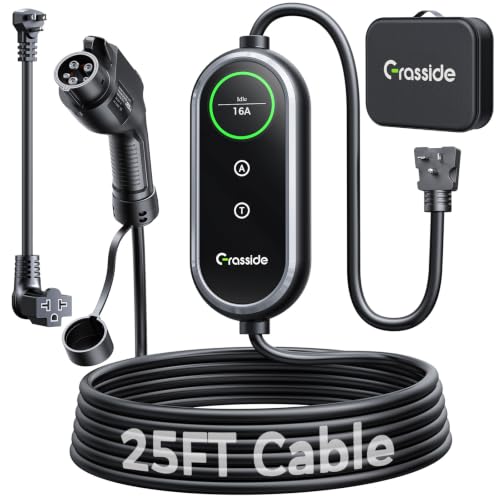
Universal J1772 Compatibility: Designed with a standard J1772 connector, this J1772 charger works with most J1772 electric vehicles and PHEVs, including BMW, Mercedes-Benz, Hyundai, Kia, Nissan, Rivian, Ford, Chevy, Volkswagen, Toyota and more. Note: Tesla vehicles require a J1772 to Tesla adapter (not included)

LEVEL 1 CHARGING - The Lectron Level 1 Charger lets you quickly charge your EV with a standard 120V outlet; You get 15 amps and 1.65 kW of power for the standard full-charge time for your car, at home or at wor

EFFICIENT LEVEL 1 CHARGING - With a NEMA 5-15 plug and 15 Amp output, this charger delivers reliable and efficient Level 1 charging, adding approximately 40-50 miles of range overnight
Home Charging vs. Public Stations: Time and Cost Compared
How does charging at home actually stack up against public stations when I’m staring at my battery gauge?
Home charging with Level 2 charging typically fills my 60 kWh battery in 4–10 hours, depending on my charger’s kW rating. My 7.4 kW unit manages a full charge in about 8 hours, while a slower 3.6 kW setup stretches to 16 hours. Public Level 2 charging mirrors these times, around 5–7 hours, though my car’s onboard limits can cap the charging rate.
DC fast charging changes everything. At 50+ kW public stations, I hit 80% in roughly 30–60 minutes. Charging efficiency drops as my battery fills, so I rarely push past 80%.
Charging cost favors home charging significantly. Public charging premiums add up fast. For daily use, I rely on home convenience; I reserve DC fast charging for road trips where charging time matters most.
Recommended Products

Universal Compatibility: This level 2 ev charger is built for all SAE-J1772 compliant electric vehicles and plug-in hybrids. Compatible with leading EV brands for efficient charging anywhere. (TSL adapter sold separately.)

FASTEST CHARGING EXPERIENCE - The TopAutoGear electric vehicle level 2 ev charger offers a maximum current output of up to 50 amps(11.5KW) At the fastest charging rate of 45 miles per hour, it takes only 5 hours to fully charge your car. The Fastest ev charging,Level 2 ev charger, ideal for home and road trips.

FAST LEVEL 2 CHARGING UP TO 46 MILES PER HOUR – Delivers up to 48 amps at 240V (11.5 kW) for up to 46 miles of range per hour. Charge overnight and wake up to a full battery in your J1772 EV