I’ve towed everything from utility trailers to 12,000-pound equipment haulers, and I can tell you that picking the wrong hitch type isn’t just inconvenient, it is dangerous. Most drivers assume a “trailer hitch” is universal, but the reality is far more specific: your bumper-mounted option might handle 3,500 pounds while a proper Class V receiver clears 20,000 pounds, and that gap matters when you are merging onto the interstate with a loaded trailer.
Receiver hitches dominate the market for good reason, their removable ball mounts and standardized 2-inch square tubes provide flexibility that permanent solutions simply cannot match. Still, I have seen too many buyers overspend on heavy-duty hardware their truck cannot actually use, or worse, underspend and watch their setup fail under load.
The real question is not which hitch looks toughest, it is which one matches your vehicle’s frame rating, your trailer’s tongue weight, and the actual work you need done. I will walk you through the eight categories that matter, from pintle hooks rated for military-grade abuse to weight-distribution systems that keep your headlights aimed where they belong. By the end, you will know exactly what to bolt to your frame, and what to leave on the shelf.
Receiver Hitches: The Most Common Trailer Hitch Design
Why do receiver hitches dominate American roads? I’ve installed dozens on everything from compact SUVs to heavy-duty trucks, and the answer is adaptability. A receiver hitch bolts directly to your tow vehicle’s frame, giving you a square hitch receiver tube that accepts removable accessories.
Trailer hitch classes range from I to V, matching your towing capacity needs. Class I handles up to 2,000 lbs with a 1¼-inch tube, while Class III jumps to 8,000 lbs using a 2-inch receiver. Heavy-duty Class V setups reach 20,000 lbs with 2½-inch tubes.
You’ll slide in a ball mount, then attach your choice of hitch ball sizes: 1-7/8″, 2″, or 2-5/16″. Proper hitch installation takes about an hour with basic tools. Always cross your safety chains. This system lets weekend warriors and contractors alike haul without commitment to one configuration.
Recommended Products

MAXIMUM STRENGTH. This class 5 hitch is engineered with a large, powerful main body to be a dependable extension of your pick up truck. It is rated for 17,000 lbs. GTW, 2,550 lbs. TW, 17,000 lbs. WD and 2,550 lbs. WDTW

Rated to 2,000 lbs. gross trailer weight and 200 lbs. tongue weight

DEPENDABLE STRENGTH — This trailer hitch is rated for 2,000 lbs. gross trailer weight and 200 lbs. tongue weight (limited to lowest-rated towing component)
Bumper Hitch or Receiver Hitch: Which Fits You?
I’ll compare bumper and receiver hitches by looking at weight capacity, where each mounts on your vehicle, and what accessories work with each setup. A bumper hitch bolts directly to your bumper with a fixed ball, usually handling 3,500 pounds or less. A receiver hitch attaches to the frame with a square tube that accepts removable ball mounts and add-ons like bike racks or cargo carriers.
If you’re hauling lightweight gear occasionally, a bumper hitch gets the job done simply. For heavier trailers or frequent switching between accessories, you’ll want a receiver hitch’s flexibility and higher ratings, typically 5,000 to 20,000 pounds depending on the class.
Recommended Products

WEIGHT DISTRIBUTION: Hardened steel chains connect the hitch arms to your trailer frame for improved load distribution. The result is improved steering, braking control, and helping to reduce stressful towing situations.

LEVEL TOWING — Distributes trailer tongue weight across the tow vehicle and trailer to help level the load, improve control and smooth the ride; includes sway control kit #17200 to help reduce trailer sway.

Allows for easy leveraging of weight distribution hookup brackets
Weight Capacity Comparison
When I’m standing in the towing aisle trying to pick the right setup, the weight capacity question always comes down to one thing: what am I actually hauling? A bumper hitch handles light duty, bike racks and small trailers, but its limited hitch weight caps out fast.
For real work, I look at receiver hitches. They scale from Class I to Class V, covering gross trailer weight from 2,000 lbs up to 12,000 lbs with weight distribution. Class I–II fit 1¼-inch tubes; Class III–V demand a 2-inch receiver for proper ball mount selection.
Here’s the catch: your towing capacity is only as strong as the weakest link. That bumper hitch won’t play nice with a Class III setup, even on the same truck.
Installation Location Differences
Where you mount your hitch changes everything about what you can tow and how your rig handles day-to-day driving. Bumper hitches bolt directly to your bumper, molded as one-piece units that keep things simple but limit your options. Receiver hitches attach to your frame, accepting inserts in common receiver sizes like 1¼-inch and 2-inch, giving you flexibility to swap components.
I choose based on three factors:
- Hitch class needs (bumper hitches typically cap at Class I–II, receivers range to Class V)
- Ground clearance concerns (bumper mounts sit lower, risking scrapes)
- Installation considerations (heavier receivers demand professional frame mounting)
Vehicle compatibility matters most here. Some trucks only accommodate lightweight bumper setups, while others handle sturdy receivers. When weighing bumper vs receiver, remember that your choice locks in or limits hitch-mounted accessories, and that trade-off shapes every trip you take.
Versatility and Accessories
Why limit yourself to one job when your hitch could handle dozens? I learned this the hard way after buying a bumper hitch for my first truck. It handled my bike rack fine, but I hit a wall when I needed real towing flexibility.
A receiver hitch changed everything for me. With hitch receiver sizes from 1¼-inch to 2-inch, and Class I-V hitches covering every trailer weight capacity, you’re covered from jet skis to heavy equipment.
The square tube accepts endless hitch accessories: cargo carriers, bike racks, and ball mounts that swap in seconds.
Bumper hitch vs receiver hitch comes down to ground clearance and growth. My bumper hitch sat low, scraping on driveways, and couldn’t accept accessories. My receiver hitch sits higher, handles more weight, and grows with my needs. That’s the difference between settling and belonging to the towing community.
Hitch Classes I–V: What Your Vehicle Can Tow
I’ve towed everything from small utility trailers to heavy equipment, and I’ll tell you straight up that matching your hitch class to your actual needs saves you from dangerous mismatches down the road. Class I and II hitches work fine for basic jobs up to 3,500 lbs.
Once you’re pulling something substantial, you’ll want Class III or IV with their 2-inch receivers and serious weight capacity. For commercial hauling or massive loads up to 20,000 lbs, Class V is the only responsible choice, even if it means upgrading your tow vehicle too.
Recommended Products
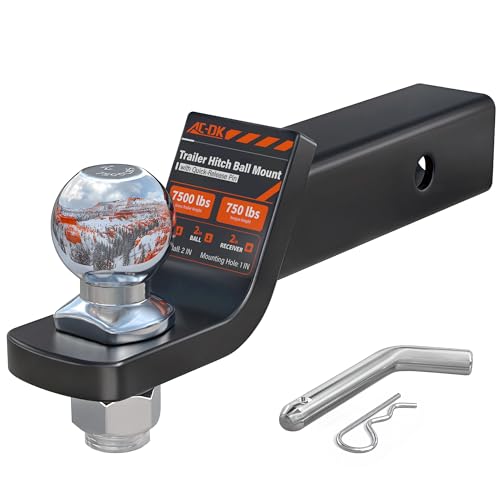
Heavy-Duty Trailer Hitch Ball Mount: Rated to tow up to 7,500 lbs GTW and 750 lbs tongue weight, this durable hitch mount is suitable for trucks, SUVs, RVs, trailers, campers, ATVs/UTVs, and boats. Designed to fit all vehicles equipped with a standard 2-inch hitch receiver

🚀PRODUCT SIZES: The Triple Ball Hitch with Hook including 1-7/8", 2" and 2-5/16"plating black balls. This three ball hitch is compatible with all standard 2" receivers.

No More Hitch Sizing Stress: Orion Motor Tech's trailer hitch ball mount features a standard 2 in. receiver size & 2 in. ball. Effortlessly connect it to your vehicle to tow everything from fishing boats to RVs, campers, and utility trailers
Class I–II Basics
How do I know which hitch class actually fits my daily driver? I’ve tested both Class I hitches and Class II hitches on compact cars and small SUVs, and the differences matter more than you’d think.
Both share the same 1-1/4 inch receiver size, which limits accessory options but keeps things simple. Class I hitches top out at 2,000 lbs GTW, perfect for bike racks or tiny utility trailers. Class II hitches jump to 3,500 lbs GTW, handling single-axle trailers with confidence.
Here’s what I check before buying:
- Verify your vehicle’s actual weight ratings, not just the hitch
- Calculate tongue weight, typically 10-15% of GTW for stable towing
- Confirm the 1-1/4 inch receiver matches your accessories
For light-duty towing, these classes give exactly what most of us need without overcomplicating our setup.
Class III–IV Power
Once you’ve maxed out what Class I and II hitches can handle, you’re looking at a serious jump in capability. Class III hitches step up with 8,000 lbs gross trailer weight and up to 1,200 lbs tongue weight when using weight distribution gear. That’s serious torque capacity for boats, campers, and utility trailers.
Class IV hitches push even further, hitting 10,000 lbs GTW without weight distribution and matching that 12,000 lbs WD ceiling. Both use the beefier 2-inch receiver hitch tube you’ll find on most trucks and SUVs today. I’ve tested rigs at these limits, and the real-world stability difference from Class II is immediately obvious.
Beyond receiver options, gooseneck setups provide comparable weight capacity for seriously heavy loads. These classes bridge weekend towing and near-commercial duty without crossing into full work truck territory.
Class V Commercial Duty
When you’re hauling serious equipment, there’s no room for “good enough.” Class V hitches represent the ceiling of standard receiver systems, and I’ve pushed these to their 20,000-lb gross trailer weight limits on heavy-duty trucks hauling commercial skid steers and loaded equipment trailers.
This commercial duty receiver hitch typically mounts with a 2-inch or 2-1/2-inch opening, and I’ve seen weight ratings climb even higher in Xtra Duty variants. Here’s what separates serious operators from the pretenders:
- Verify your vehicle’s actual towing capacity matches the hitch rating
- Confirm tongue weight limits, usually 2,000–2,700 lbs
- Remember, your weakest component dictates the real limit
Class V handles gooseneck adapters, though dedicated heavy-duty hitch systems often outperform them. I’ve learned the hard way: max ratings mean nothing if your ball mount or frame can’t handle the load.
Trailer Hitch Receiver Sizes: 1¼” vs. 2″ vs. 2½”
Why does receiver size actually matter when I’m standing in the trailer aisle staring at three nearly identical square tubes? I’ve learned the hard way that receiver sizes dictate everything about what I can actually tow.
The 1¼-inch receiver handles my light-duty needs, pairing with Class I and II hitch classes for smaller loads. When I step up to medium trailers, the 2-inch receiver becomes my go-to, matching Class III and IV ratings with solid gross trailer weight and tongue weight limits. For serious hauling, the 2½-inch receiver provides commercial-grade towing capacities.
Vehicle compatibility remains my starting point. I can’t just bolt on a bigger receiver; my truck’s frame and ratings set the ceiling. I match my hitch classes to real-world demands, knowing that oversized hardware on an underrated frame won’t boost my actual limits.
Recommended Products

Fits trailer hitches with a 2" x 2" receiver tube opening

SAFE, SMOOTH TOWING: Reduce trailer slack and prevent wear on your towing system—air cushioning absorbs shock between drawbar and hook for safer, smoother towing on any terrain

Material: Pintle hitch is solidly forged from high-strength, high-carbon steel. Black powder-coated finish for corrosion and wear resistance, ensuring long-term stable towing performance, even in harsh environments.
5th Wheel and Gooseneck Towing: Heavy-Duty Hitch Options
Receiver hitches top out at a certain point, and I’ve found that point arrives faster than most people expect. When you’re hauling serious weight, you need a bed-mounted hitch system that puts the connection where it belongs: directly over your truck’s rear axle.
Heavy-duty towing changes everything about how your rig handles. A fifth-wheel hitch uses a kingpin that slides into jaws mounted in your pickup bed, giving you towing capacity up to 30,000 lbs with outstanding trailer stability. I’ve watched these transform white-knuckle hauls into confident drives.
Gooseneck hitches drop a ball into that same pickup bed location, pushing limits even further to around 38,000 lbs. The tighter turning radius saves you in crowded job sites, and the simpler design means fewer parts to maintain.
Both excel with commercial trailers, but they serve different crews:
- Fifth-wheel hitch: massive RVs, living quarters, smoother ride
- Gooseneck hitch: agricultural equipment, flatbeds, raw capacity
- Either choice: bed-mounted installation, superior control, investment-grade hardware
Choose based on your trailer’s coupler. Match once, haul forever.
Recommended Products

Quick, Easy Installation: No need for complicated welding to make the Ohuhu Hitch Receiver work. You can hook it up to a bicycle rack, RV tire rack, cargo rack or other accessories. Simply install it on the bumper and you are good to go.

APPLICABILITY: Designed for standard 2" x 2" trailer hitches, this hitch adapter is compatible for most Class III/IV ball mounts, bike racks, tow vehicles, tow cargos.

STANDARD 2" RECEIVER DESIGN: Features a universal 2-inch receiver opening, compatible with most hitch-mounted bike racks, cargo carriers, and other RV accessories.
Weight Distribution Hitches: Leveling Heavy Loads Safely
Even with a capable receiver hitch, I’ve watched trailers sag tow vehicles until headlights point skyward and steering goes vague; that’s where a weight distribution hitch earns its keep. These systems redistribute tongue weight across both axles of your tow vehicle and trailer, leveling everything out for proper towing stability.
I install the spring arms onto Class 3 hitches rated for up to 15,000 lbs GTW, though I always check the WDTW rating, typically around 1,200 lbs for mid-range setups. The load distribution happens through those spring arms or chains, which actively transfer weight back to your front wheels, improving braking and steering response.
Overload avoidance means matching every component: vehicle, hitch, and trailer ratings. Skip this step, and you’re gambling with safety.
Recommended Products

Towing Capacity (GTW/TW):3,500 lbs./525 lbs.; Receiver Tube Size: 2"; Black Powder Coated Finish;

DEPENDABLE STRENGTH — This trailer hitch is rated for 4,000 lbs. gross trailer weight, 400 lbs. tongue weight, 5,000 lbs. weight distribution capacity and 500 lbs. weight distribution tongue weight, limited to the lowest-rated towing component.

Rated to 5,000 lbs. gross trailer weight and 500 lbs. tongue weight
Pintle Hitches and Heavy-Duty Couplers: Maximum Capacity Towing
When I’m hauling serious weight beyond what standard receiver hitches can handle, I move up to pintle hitches. These heavy-duty towing solutions pair a pintle hitch with a lunette ring, creating a trailer coupling that handles extreme loads, often reaching 60,000 lbs in maximum capacity setups.
I’ve found three key advantages that matter for serious work:
- Superior vertical and angular movement for rough terrain
- Durability that outlasts standard ball mounts under stress
- Simpler maintenance in agricultural and military conditions
Heavy-duty couplers include gooseneck and fifth-wheel options too, but pintle systems mount differently and excel where flexibility beats comfort. Your towing capacity depends on matching the lunette ring geometry precisely. For industrial, farm, or commercial hauling, this setup gives you confidence standard hitches simply can’t match.
Recommended Products

Provides an adjustable mount for any CURT weight distribution hitch

【Wide Application】: fit for 2-inch x 2-inch receiver tube openings with 5/8-inch hitch pin hole, and is compatible with any CURT weight distribution hitch.

FOR SMOOTH AND STABLE TOWING: Replacement Hitch Brackets Provide A Rock-Solid Connection, Ensuring Your Trailer Or Caravan Towing Experience Is Smooth And Stable, Whether You're Hauling Heavy Loads Or Navigating Challenging Terrain. For Smoother And Safer Travelling
Specialty Hitches: RV, Front-Mount, and Custom Fit Options
Vehicles rarely read the rulebook regarding towing, and that’s exactly why specialty hitches exist. When standard receivers won’t cut it, you’re joining a community that demands more from their equipment.
RV hitches mount directly to motorhome frames for trailer or dinghy towing, handling unique weight distributions that standard hitches can’t manage. They’re built for the long haul.
Built for the long haul, RV hitches handle weight distributions that standard hitches simply can’t manage.
Front-mount hitches bolt to your vehicle’s front end. I use mine for winches and snow plows, accessing angles impossible from the rear.
Custom-fit hitches are the precision option. These vehicle-specific hitches optimize clearance and fit for your exact make and model, often exceeding generic load ratings.
Specialty tow hitches demand professional hitch installation. Don’t guess on fabrication; your safety depends on proper alignment and secured hardware.
Recommended Products
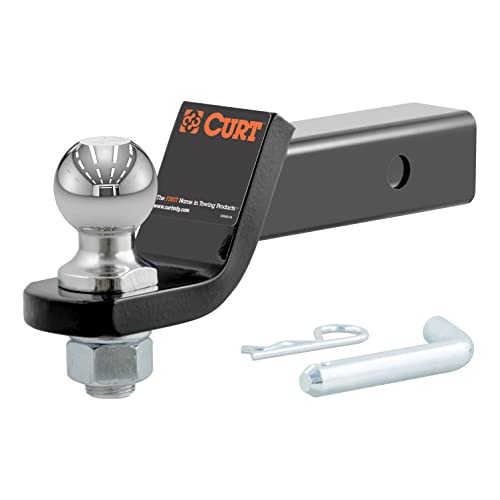
DEPENDABLE STRENGTH - Rated to tow 7,500 pounds gross trailer weight and 750 pounds tongue weight, this ball hitch offers dependability for your towing setup (weight capacity may change if trailer ball is removed)

DEPENDABLE STRENGTH. Rated to tow 7,500 pounds gross trailer weight and 750 pounds tongue weight, this ball hitch offers dependability for your towing setup (weight capacity may change if trailer ball is removed)

HIGH STRENGTH: Adjustable trailer hitch ball mount is rated for 7500 lbs gross trailer weight this hitch adapter is constructed from quality steel to offer dependable strength
Choosing the Right Hitch Class and Type for Your Setup
Specialty hitches solve specific problems, but most of us need to nail the fundamentals first. I always start by matching my hitch class to my vehicle’s limits and what I’m actually hauling. Here’s my checklist for getting it right:
- Check your vehicle’s towing capacity first, it’s your hard ceiling
- Match receiver hitch tube size: 1¼-inch for light duty, 2-inch for Class III and Class IV setups
- Verify every component, ball mount included, meets or exceeds your load
For weekend projects and midsize trailers, Class III handles up to 8,000 lbs. Step up to Class IV when you’re pushing 10,000 lbs.
Heavy RV life? You’ll want a gooseneck hitch or fifth-wheel hitch mounted in your truck bed, they crush standard receiver limits. Always respect tongue weight ratings, they’re your safety margin.
Recommended Products

HEAVY DUTY TOWING STRENGTH: This 15 ton pintle hook hitch delivers up to 30,000 lbs towing power and 6,000 lbs MVL, engineered for demanding hauling applications using a durable bolt‑on design ideal for heavy duty towing and pintle hitch setups.

For 2 1/2 IN x 2 1/2 IN receiver tubes

NOTE: This product has been sanded.