Wondering about Jeep Wrangler stock tire sizes but feeling overwhelmed by conflicting information? You’re not alone. Understanding the factory tire specifications for your exact Wrangler model is crucial whether you’re replacing worn tires or planning an upgrade.
Jeep Wranglers come equipped with different stock tire sizes depending on the model year, trim level, and package options. While the JL generation typically features 245/75R17 or 255/70R18 tires, older JK models often came with 225/75R16 or 255/75R17 options. These differences matter significantly when considering replacement tires or calculating clearance for potential upgrades.
Understanding Jeep Wrangler Stock Tire Sizes
Jeep Wrangler stock tire sizes vary significantly across different generations and trim levels. Each Wrangler model comes equipped with exact tire dimensions designed to optimize performance for its intended use. These dimensions are typically expressed in a format like “255/75R17,” which represents the tire width (255mm), aspect ratio (75% of width), and rim diameter (17 inches).
Knowing your Jeep’s stock tire size is crucial for maintaining proper vehicle performance. The right tire dimensions ensure accurate speedometer readings, appropriate ground clearance, and optimal fuel efficiency. Many Wrangler owners don’t realize that incorrect tire sizing can affect their vehicle’s handling characteristics and drivetrain components.
Tire size information can be found in several locations on your Jeep. Check the driver’s side door jamb for a sticker containing vehicle specifications, including the factory tire size. The owner’s manual also lists this information in the technical specifications section. Also, you can simply look at the sidewall of your current tires if they’re the original equipment.
Different Wrangler models use various tire sizes based on their intended purpose. Sport models typically come with more road-oriented tires, while Rubicon editions feature larger, more aggressive tires for enhanced off-road capability. Understanding these differences helps you make informed decisions when replacing worn tires or considering upgrades for your exact driving needs.
Stock Tire Sizes by Jeep Wrangler Generation
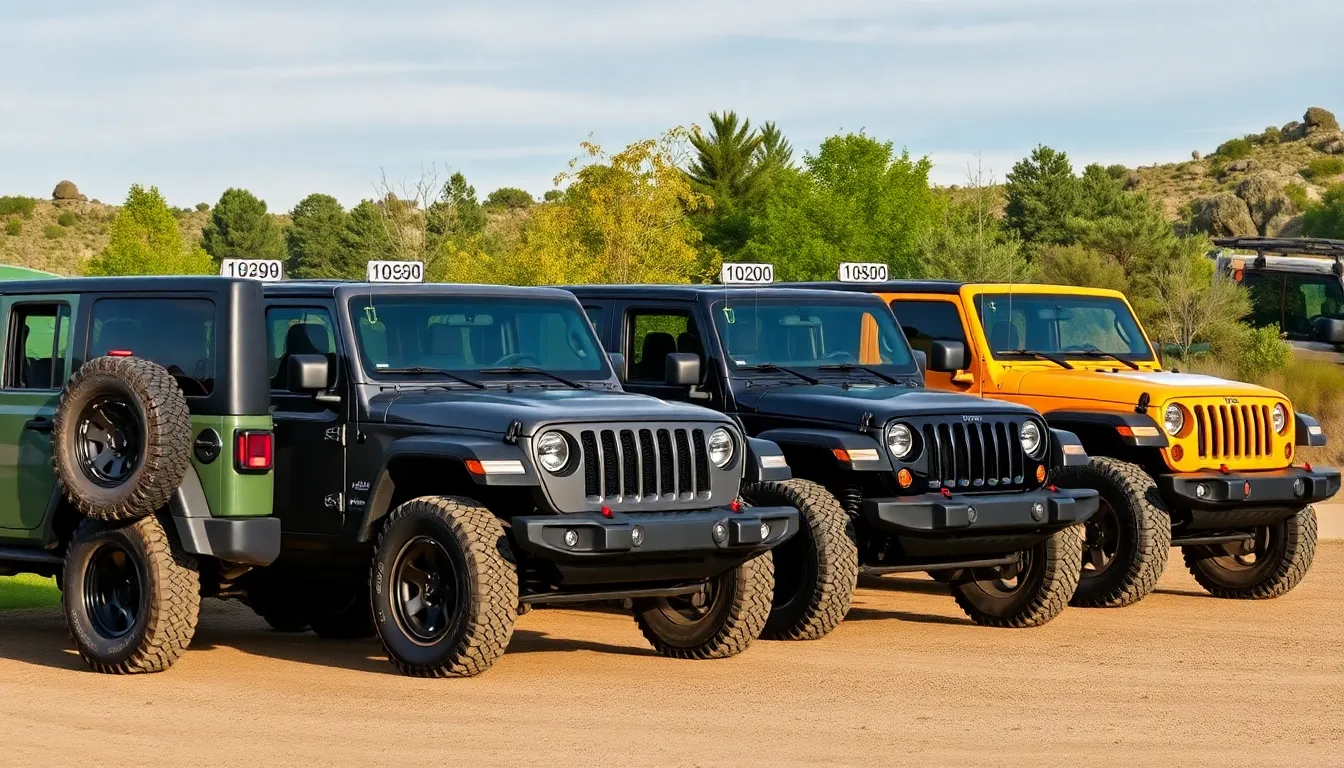
Each Jeep Wrangler generation comes with exact stock tire sizes that vary based on trim level and intended use. Let’s explore the standard tire dimensions across all four major Wrangler generations to help you identify the correct specifications for your vehicle.
JL Wrangler (2018-Present) Stock Tire Sizes
The current JL Wrangler generation offers multiple wheel diameter options ranging from 17 to 20 inches depending on trim level. Most common JL trims feature 17, 18, or 20-inch tires, with no 19-inch option available from the factory. Trim levels determine the exact tire size, with more premium and off-road oriented models receiving larger tire packages. The JL generation represents Jeep’s most diverse tire sizing yet, giving owners various stock configurations to match their driving needs.
JK Wrangler (2007-2018) Stock Tire Sizes
JK Wranglers marked a important increase in standard tire dimensions, with 255/75R17 becoming the most common stock size across most models. Base JK trims sometimes came equipped with slightly smaller 245/75R17 tires. Early production JK models occasionally featured 245/75R16 tires before standardizing on the 17-inch wheel diameter. This generation established larger tires as the norm for Wranglers, with 17-inch wheels becoming standard and options for 16 and 18-inch wheels available on certain trims.
TJ Wrangler (1997-2006) Stock Tire Sizes
TJ Wranglers maintained the 225/75R15 size from the previous generation for Sport and SE trims, providing continuity for owners upgrading from YJ models. Higher-end Sahara and Rubicon trims received larger 245/75R16 tires for improved ground clearance and off-road performance. The TJ generation introduced 16-inch tire options to the Wrangler lineup while keeping 15-inch tires standard on base models, creating a clear distinction between entry-level and premium trims.
YJ Wrangler (1987-1995) Stock Tire Sizes
YJ Wranglers primarily came equipped with 225/75R15 tires across most models, establishing this as the standard size for this generation. Base YJ models were sometimes fitted with slightly smaller 205/75R15 tires to reduce costs on entry-level trims. The YJ generation exclusively used 15-inch wheels, with the 225/75R15 size preferred for its improved off-road capability compared to smaller alternatives.
| Generation | Years | Common Stock Tire Size | Alternate Sizes |
|---|---|---|---|
| YJ | 1987-1995 | 225/75R15 | 205/75R15 |
| TJ | 1997-2006 | 225/75R15 | 245/75R16 |
| JK | 2007-2018 | 255/75R17 | 245/75R17, 245/75R16 |
| JL | 2018-Present | 17″, 18″, 20″ tires | No 19″ option |
Decoding Jeep Wrangler Tire Size Specifications
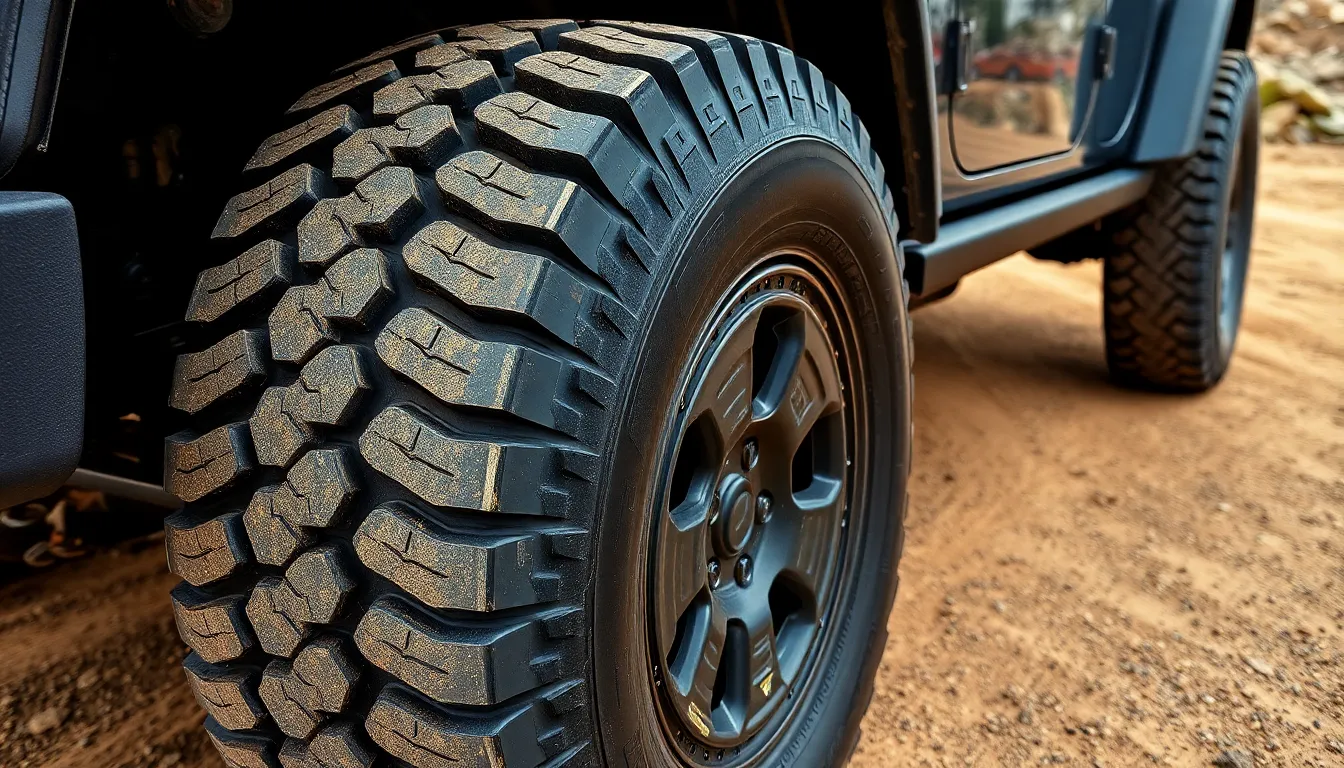
Tire size specifications on Jeep Wranglers follow a standardized format that contains vital information about the tire’s dimensions. Understanding these numbers helps you make informed decisions when replacing or upgrading your Wrangler’s tires.
What the Numbers Mean
Jeep Wrangler tire sizes consist of three main numerical components that provide exact dimensional information. The first number (such as 255) represents the tire width in millimeters across the tread. Following this, the second number (like 75) indicates the aspect ratio, expressing the sidewall height as a percentage of the width. The letter “R” signifies radial construction, which is standard for modern tires. Finally, the last number (such as 17) specifies the wheel diameter in inches that the tire fits. For example, in a 255/75R17 tire commonly found on JK Wranglers, the tire is 255mm wide with a sidewall height that’s 75% of that width, designed for a 17-inch wheel.
Aspect Ratio and Sidewall Height
Aspect ratio directly determines your Jeep Wrangler’s sidewall height, significantly affecting both ride quality and off-road performance. Higher aspect ratios create taller sidewalls, providing better cushioning over rough terrain and additional flexibility for rock crawling. A 255/75R17 tire delivers more sidewall flex than a 255/60R17, offering enhanced off-road capability and a smoother ride. Lower aspect ratios result in shorter sidewalls that improve on-road handling and responsiveness but typically create a firmer ride. Many Rubicon models come equipped with 285/70R17 tires that balance decent sidewall height with reasonable on-road performance. Selecting the right aspect ratio depends on your primary driving conditions—higher for predominantly off-road use and lower for mainly highway driving.
Benefits of Keeping Stock Tire Sizes
Maintaining your Jeep Wrangler’s stock tire size offers several practical advantages for both daily driving and long-term vehicle care. Compatible stock tires fit perfectly with your vehicle’s wheels and suspension without requiring modifications, ensuring proper clearance and alignment throughout your driving experience.
Your Wrangler’s factory tire specifications were selected by engineers to optimize the vehicle’s weight distribution and performance characteristics, providing balanced handling and traction in various conditions. These tires undergo extensive testing to match your exact Wrangler model, whether it’s a JK with 245/75R17 tires or a Rubicon JL sporting 285/70R17 rubber.
Warranty protection remains intact when you stick with stock sizes, as deviating from manufacturer recommendations may void certain coverage terms. Many Jeep owners discover this crucial detail only after making modifications that affect their vehicle’s warranty status.
Finding replacements becomes much easier and more cost-effective with stock sizes, as these tires are widely available from multiple manufacturers and frequently offered at competitive prices during sales. The popularity of standard sizes like 255/75R17 for JK models means you’ll rarely struggle to find suitable replacements when needed.
Safety considerations also favor stock tire dimensions, as these sizes have been thoroughly validated by Jeep engineers to ensure reliability across various driving conditions. Your vehicle’s braking distance, stability control systems, and overall handling characteristics were calibrated specifically for these tire dimensions.
Speedometer accuracy depends on maintaining the correct tire circumference, which stock sizes preserve without requiring recalibration. Fuel efficiency also remains optimized with factory tire specifications, avoiding the increased resistance that often accompanies oversized alternatives.
Consumer experience shows that many Wrangler owners who temporarily switched to non-stock sizes eventually return to factory specifications after experiencing compromises in on-road comfort, fuel economy, or everyday drivability.
When to Upgrade From Stock Tire Sizes
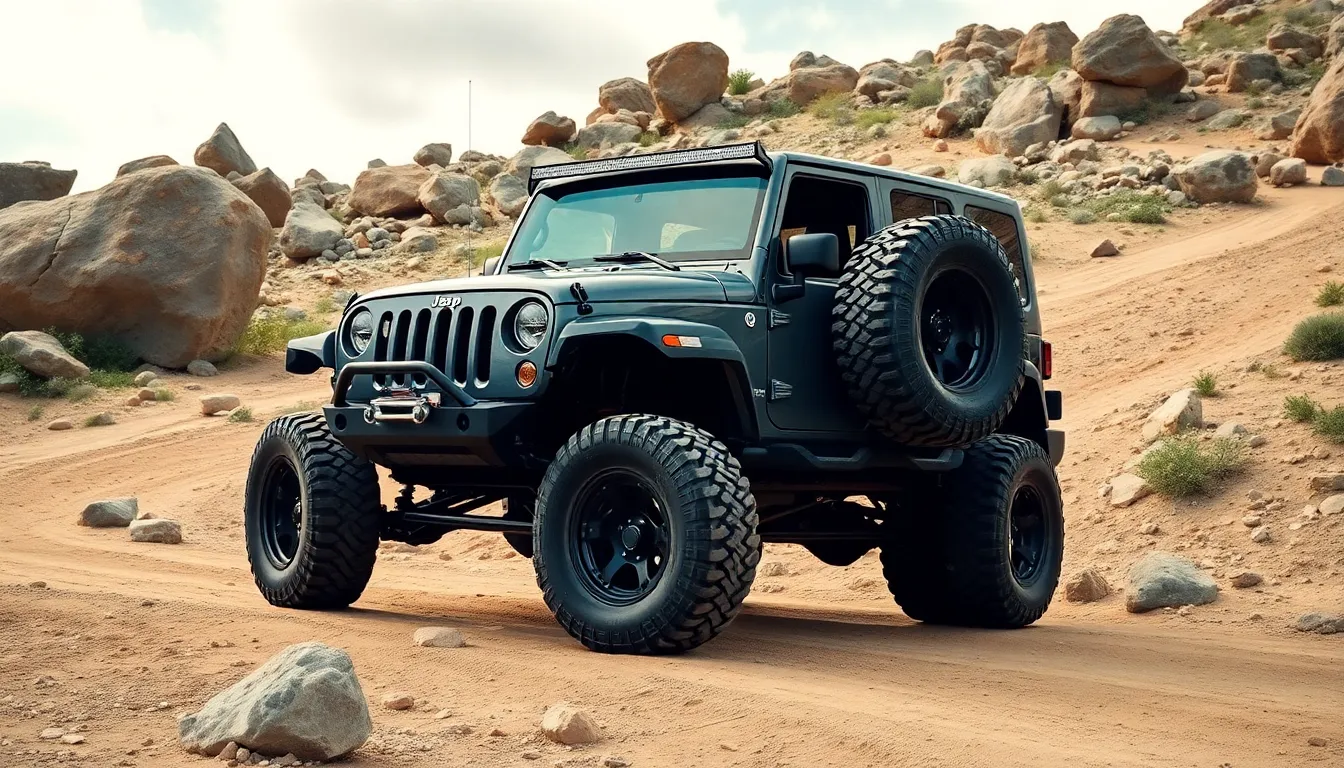
Upgrading your Jeep Wrangler’s tires is a important decision that depends on your driving needs and vehicle modifications. The stock tires are designed for balanced performance, but many owners find themselves wanting more from their Wrangler’s capabilities.
Signs It’s Time for an Upgrade
Your off-road adventures demand better capability than stock tires can provide. Frequent trail riding, rock crawling, or mudding often exposes the limitations of factory tires, which aren’t optimized for extreme conditions. Traction issues on challenging terrain indicate you’ve outgrown your stock setup and need something more aggressive. Poor performance in exact weather conditions, such as deep snow or slick mud, suggests specialized tires would better serve your driving environment.
Ground clearance limitations become apparent when you find yourself scraping over obstacles that other modified Wranglers clear with ease. Stock tires typically provide adequate clearance for light off-roading, but serious trails require additional height that only larger tires can provide.
Upgrade Considerations After Lift Installation
Installing a lift kit creates the perfect opportunity to upgrade your tire size. A 2.5-inch lift or higher practically begs for larger tires to maximize the benefits of your suspension investment. The additional clearance from a lift kit allows for tires up to 33 inches in diameter without risking rubbing issues against fenders or suspension components.
Lift kits and larger tires work together synergistically – the lift provides the clearance while larger tires deliver improved ground clearance, better traction, and enhanced off-road capability. Keeping stock tires after installing a lift kit leaves your Wrangler looking awkward with excessive wheel well gap, often called the “sky-high” look among Jeep enthusiasts.
Performance-Based Upgrade Timing
Tire performance degradation signals an ideal time to consider upgrades rather than direct replacements. Important tread wear on stock tires presents a natural opportunity to transition to upgraded sizes or more specialized tread patterns. Handling issues that weren’t present when your Jeep was new might indicate your driving needs have evolved beyond what the factory setup can deliver.
Off-road performance limitations become increasingly frustrating as you gain experience and tackle more challenging trails. Many Wrangler owners discover that stock tires, even on Rubicon models, compromise too much for on-road comfort at the expense of true off-road capability.
Popular Upgrade Options
The 31-inch to 33-inch diameter range represents the sweet spot for most Wrangler tire upgrades. These sizes offer substantial improvements in capability without requiring extensive modifications beyond basic lift kits. Tires sized at 31″ x 10.50″ fit nicely on factory 15″ or 16″ wheels with moderate lift kits, providing an entry-level upgrade path for newer off-roaders.
Mid-range options including 32″ x 11.50″ and 32″ x 12.50″ tires pair well with aftermarket wheels sized from 15″ to 20″ with proper offset adjustments. These sizes deliver a balanced compromise between on-road comfort and off-road capability. The increased width provides a wider footprint for better traction in loose conditions.
Serious off-roaders often gravitate toward 33″ x 12.50″ tires mounted on 20″ x 10″ aftermarket wheels with exact negative wheel offsets (-19 to -18mm). This combination maximizes ground clearance and provides aggressive sidewall lugs for rock crawling and extreme terrain. Rubicon owners commonly upgrade to 285/70R17 or 255/75R17 tires to maintain the optimal balance for their enhanced factory suspension components.
Tire width considerations are just as important as diameter when upgrading. Wider tires provide better traction in sand, mud, and snow but may require wheel spacers or wheels with different backspacing to prevent rubbing against suspension components. The right combination of tire size, wheel specifications, and suspension modifications ensures proper fit and optimized performance for your exact driving needs.
How Stock Tire Size Affects Performance
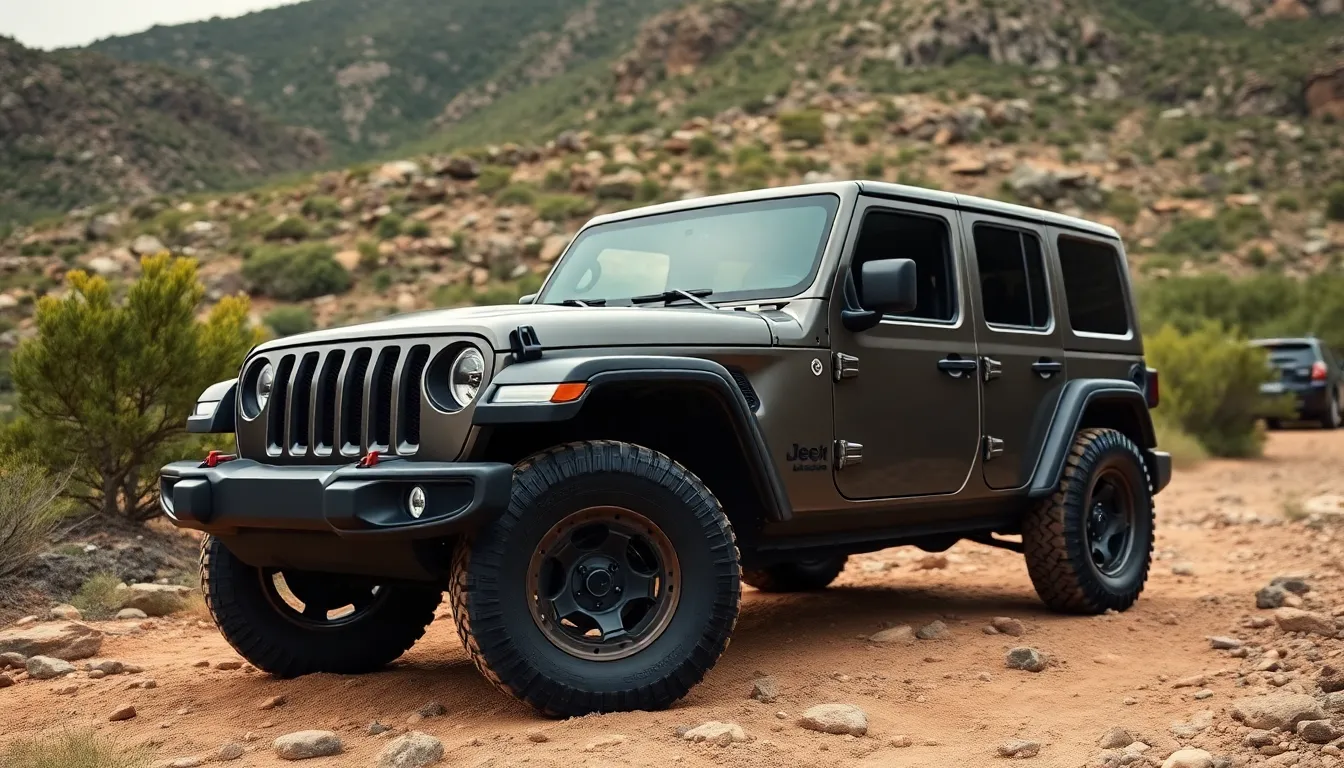
Stock tire sizes on Jeep Wranglers significantly impact overall vehicle performance in multiple ways. These factory-selected dimensions create a carefully engineered balance between on-road handling and off-road capability.
Your Wrangler’s handling characteristics depend heavily on tire size. Stock tires provide optimal stability during daily driving while maintaining enough traction for moderate trail use. Larger tires (like the 33-inch options on Rubicon models) improve ground clearance and obstacle traversal but slightly reduce handling precision on pavement. Acceleration response decreases marginally with bigger, heavier tires since the engine must overcome greater rotational mass. Braking distances typically increase with larger tire diameters for the same reason – more mass requires more force to stop effectively.
Steering effort also varies with tire size. Wranglers with factory tires offer balanced steering resistance, while larger aftermarket options often increase steering effort, particularly at low speeds or when handling off-road terrain with important traction.
Fuel Economy Considerations
Stock tire sizes optimize your Jeep Wrangler’s fuel efficiency within its performance parameters. Factory specifications balance tread pattern, rubber compound, and dimensions to maximize mileage while maintaining durability. Increasing tire size beyond stock typically leads to a measurable drop in fuel economy due to greater weight and rolling resistance. The 2024 Rubicon’s 33-inch tires (285/70R17) represent the upper limit of what Jeep engineers determined acceptable for fuel consumption without compromising capability.
Rotating mass plays a crucial role in efficiency – each pound added to your tires requires more energy to accelerate and maintain speed compared to static weight elsewhere on the vehicle. Keeping factory tire dimensions helps maintain the EPA fuel economy ratings advertised for your exact Wrangler model.
Off-Road Capability
Stock tire sizes on Jeep Wranglers demonstrate remarkable off-road performance even before modifications. The 33-inch tires equipped on Rubicon models provide substantial ground clearance, favorable approach and departure angles, and excellent traction across varied terrain without requiring lift kits or fender modifications.
Tread patterns on stock tires vary by trim level to match expected use cases. Sport models feature more road-biased patterns that still perform adequately on light trails, while Rubicon editions include aggressive all-terrain designs with reinforced sidewalls for rock crawling and technical sections.
Factory tire dimensions for the Wrangler JK (2007-2018) typically range from 255/75R17 to 285/75R17, offering a balance of on-road stability and off-road capability. These sizes provide enough sidewall flex for trail driving while maintaining predictable handling characteristics during highway travel. The current JL generation continues this approach with similar sizing options customized to each trim level’s intended use.
Conclusion
Understanding your Jeep Wrangler’s stock tire size is more than just a technical detail—it’s essential knowledge for maintaining your vehicle’s performance. Whether you stick with factory specifications or upgrade to larger tires your decision should align with your driving habits and vehicle setup.
Stock tire sizes offer balanced performance reliability and warranty protection while upgrades can enhance ground clearance and off-road capability. Remember to check your door jamb owner’s manual or tire sidewall for your exact model’s dimensions.
The right tire choice makes all the difference in your Wrangler experience both on highways and trails. Armed with this knowledge you’ll make confident decisions that keep your Jeep performing at its best for years to come.
Frequently Asked Questions
What are the standard tire sizes for the current JL Jeep Wrangler?
The JL Wrangler (2018-Present) typically comes with 245/75R17 or 255/70R18 tires, depending on the trim level. Sport models feature more road-oriented tires, while Rubicon editions come with larger, more aggressive 285/70R17 tires for enhanced off-road capability. Premium trim levels may offer wheel diameter options ranging from 17 to 20 inches.
How do I find my Jeep Wrangler’s stock tire size?
You can find your Jeep’s stock tire size in three easy places: on the driver’s side door jamb sticker, in your owner’s manual, or on the sidewall of your current tires (if they’re original). The tire size will be displayed in a format like “255/75R17,” which indicates width, aspect ratio, and rim diameter.
What do the numbers in a tire size like “255/75R17” mean?
In a tire size like 255/75R17, the first number (255) indicates tire width in millimeters. The second number (75) represents the aspect ratio—sidewall height as a percentage of width. The “R” stands for radial construction, and the last number (17) specifies the wheel diameter in inches.
How do stock tire sizes differ between Wrangler generations?
Each Wrangler generation uses different stock tire sizes: JL (2018-Present) uses 245/75R17 or 255/70R18; JK (2007-2018) standardized on 255/75R17; TJ (1997-2006) used 225/75R15 for base trims and 245/75R16 for higher-end models; YJ (1987-1995) primarily used 225/75R15 tires, with some base models having 205/75R15 tires.
How does aspect ratio affect my Jeep’s performance?
Higher aspect ratios create taller sidewalls that provide better cushioning over rough terrain, making them ideal for off-roading. Lower aspect ratios improve on-road handling but result in a firmer ride. Most Rubicon models use 285/70R17 tires to balance off-road capability with reasonable on-road performance.
What are the benefits of keeping stock tire sizes on my Wrangler?
Keeping stock tire sizes ensures proper fit with your vehicle’s wheels and suspension, maintains warranty protection, preserves speedometer accuracy and fuel efficiency, and simplifies finding replacements. Factory sizes have been extensively tested for reliability and safety, optimizing the balance between on-road comfort and off-road capability.
When should I consider upgrading from stock tire sizes?
Consider upgrading when you experience poor performance in challenging weather conditions, need more ground clearance for off-roading, or after installing a lift kit. Upgrade if your driving needs have changed significantly from what the stock tires were designed for, such as more frequent off-road adventures.
What size tire upgrades work best for most Wrangler owners?
For most Wrangler owners, tires in the 31-inch to 33-inch range (like 285/70R17) provide improved capability without requiring extensive modifications. These sizes offer a good balance between off-road performance and on-road drivability. Consider both diameter and width when upgrading for optimal performance.
How do larger tires affect my Jeep’s fuel economy?
Larger tires typically decrease fuel efficiency due to increased weight, rolling resistance, and aerodynamic drag. The larger and heavier the tire, the more energy required to rotate it. Most Wrangler owners report a 1-3 MPG reduction when upgrading to significantly larger tires from stock sizes.
Will changing my tire size affect my speedometer accuracy?
Yes, changing to non-stock tire sizes will affect your speedometer accuracy. Larger tires cover more distance per rotation, causing your speedometer to read slower than your actual speed. Smaller tires have the opposite effect. This can be corrected with a recalibration or aftermarket device like a programmer.