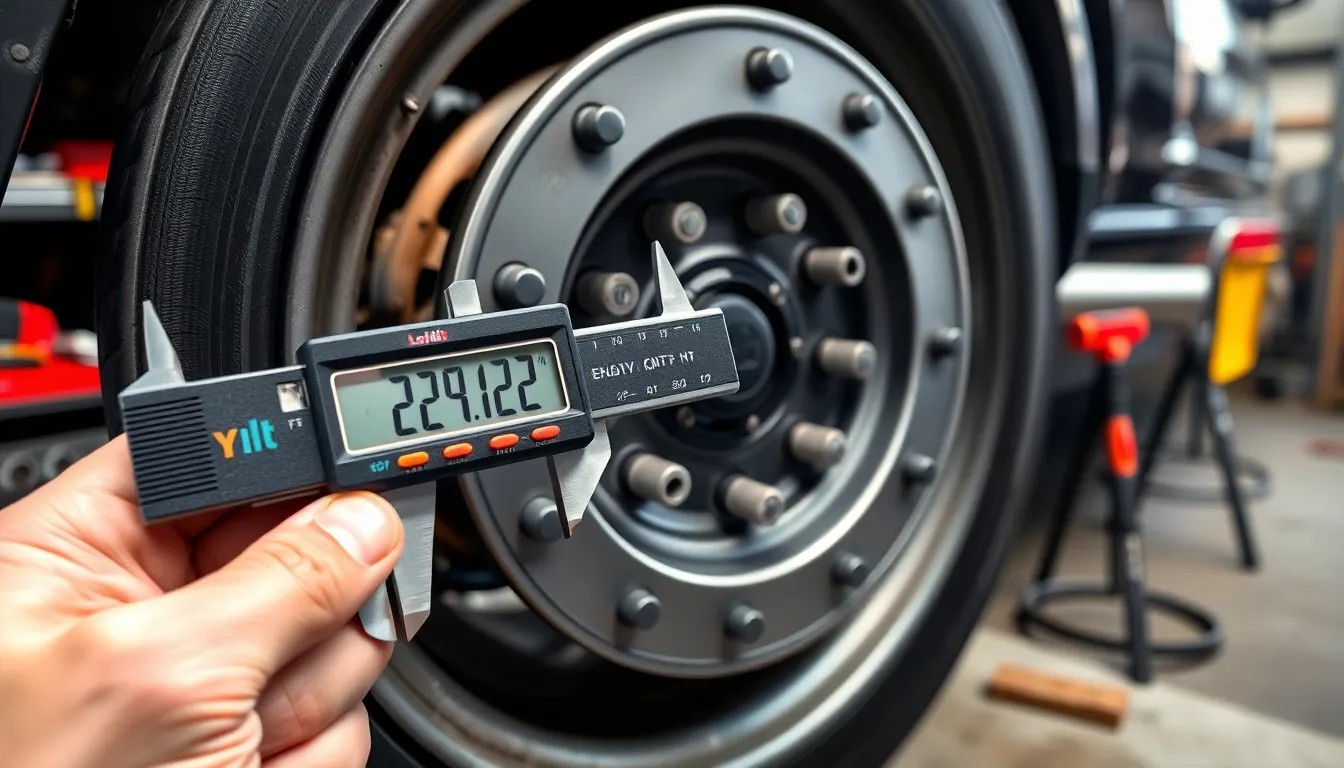
Wondering how to determine bolt pattern on wheels before making a purchase? This crucial measurement ensures your new wheels will fit your vehicle perfectly—get it wrong, and you’ll be stuck with unusable parts and wasted money.
Identifying your wheel’s bolt pattern doesn’t have to be complicated, even if you’re not mechanically inclined. Whether you’re upgrading your vehicle’s look with aftermarket wheels or replacing damaged ones, understanding how to measure bolt patterns correctly will save you time, money, and frustration. In this guide, we’ll walk you through the simple steps to determine your vehicle’s exact bolt pattern configuration.
Understanding Wheel Bolt Patterns
Wheel bolt patterns represent the exact arrangement of lug holes on your wheel. This crucial measurement determines which wheels will fit your vehicle correctly and affects both safety and performance.
What Is a Bolt Pattern?
A bolt pattern consists of two numbers that indicate the configuration of lug holes on your wheel. The first number represents the quantity of bolt holes (typically 4, 5, 6, or 8), while the second number indicates the diameter of the imaginary circle formed by these holes, measured in millimeters or inches. For example, a “5×114.3” pattern means the wheel has 5 lug holes arranged in a circle with a 114.3mm diameter. Different vehicle manufacturers use exact bolt patterns across their vehicle lines, with common patterns including 4x100mm for compact cars, 5×114.3mm for many sedans and SUVs, and 8×165.1mm for heavy-duty trucks.
Why Bolt Patterns Matter
Bolt patterns directly impact wheel compatibility with your vehicle. Using wheels with incorrect bolt patterns prevents proper installation, creates unsafe driving conditions, and potentially damages your vehicle’s hub assembly. Even slight pattern differences make wheels incompatible – a 5×114.3mm pattern won’t fit a vehicle designed for 5x115mm even though the minimal 0.7mm difference. Knowing your vehicle’s exact bolt pattern saves time and money when shopping for new wheels by narrowing your search to compatible options only. It also prevents the frustration of purchasing wheels that don’t fit and having to return them, which often incurs restocking fees or shipping costs.
Tools Needed to Measure Bolt Patterns
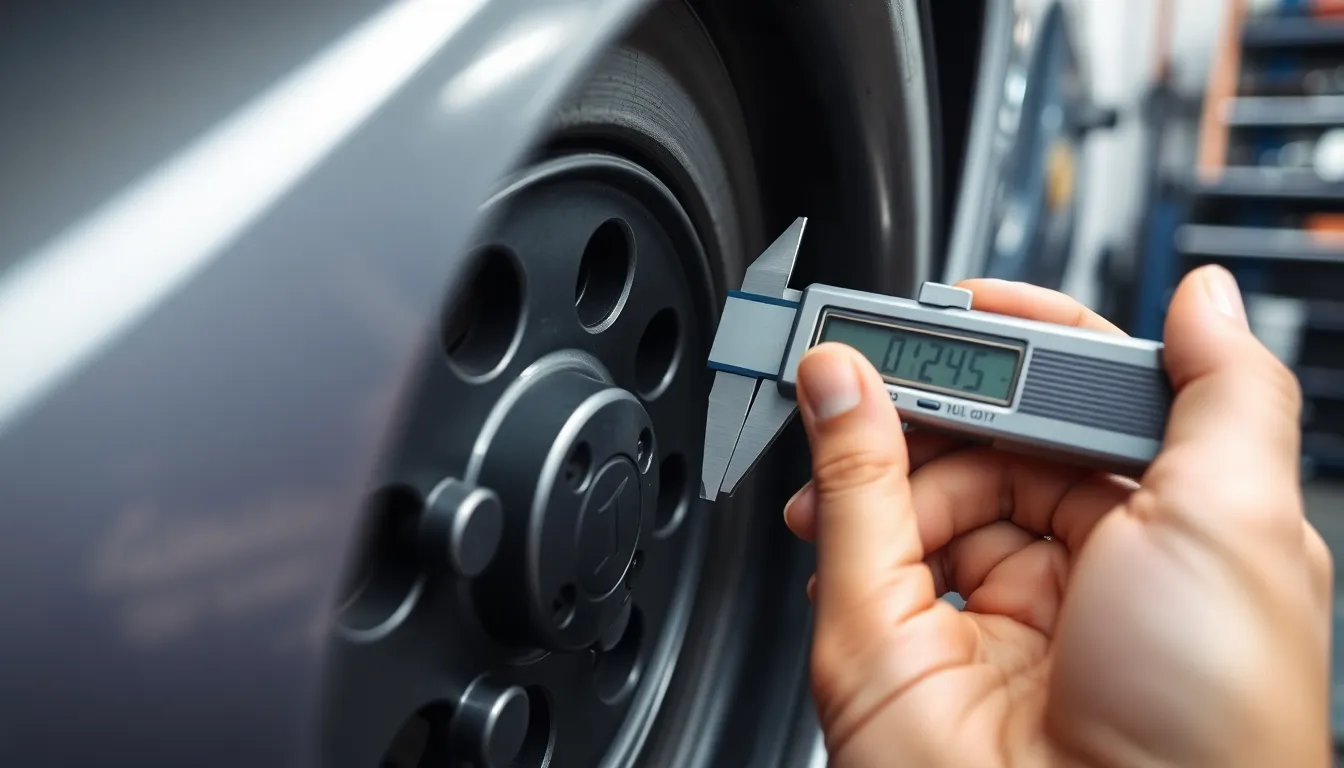
Accurate measurement of wheel bolt patterns requires exact tools to ensure you get the correct specifications. Having the right equipment makes the process straightforward and helps avoid costly mistakes when purchasing new wheels.
Basic Measurement Tools
A standard ruler or tape measure serves as the most essential tool for determining bolt patterns on your wheels. You’ll need this to measure the distance between lug holes or across the bolt circle diameter. Calipers provide more precise measurements when determining the exact centers of lug holes, eliminating guesswork that can lead to incorrect wheel purchases. Digital calipers offer the advantage of displaying measurements in both imperial and metric units, which is helpful since bolt patterns are commonly listed in both systems depending on the manufacturer.
Specialized Bolt Pattern Gauges
Bolt pattern gauges are purpose-built tools designed specifically for quick and accurate wheel measurements. These gauges feature adjustable arms that fit directly into the lug holes, instantly revealing the exact bolt circle diameter without complex calculations. Professional wheel shops rely on these tools for their accuracy and efficiency when helping customers find compatible wheels. Some advanced bolt pattern gauges include built-in charts for common vehicle fitments, making identification even faster. For DIY enthusiasts who frequently swap wheels or work on multiple vehicles, investing in a dedicated bolt pattern gauge saves time and prevents the frustration of ordering incorrect wheels based on imprecise measurements.
How to Measure 4-Lug Bolt Patterns

Measuring a 4-lug bolt pattern is one of the simplest wheel measurements you’ll encounter. The straightforward process requires just a few steps to accurately determine your wheel’s bolt circle diameter (BCD).
The Direct Measurement Method
The direct measurement method provides a reliable way to determine your 4-lug bolt pattern. First, count the lug holes to confirm you’re working with a 4-lug wheel. Next, position your measuring tool across the wheel, from the center of one lug hole directly to the center of the opposite hole. This measurement gives you the bolt circle diameter in millimeters. For example, measuring 100mm across means your wheel has a 4x100mm bolt pattern, common in many compact cars. This method works because 4-lug patterns form a perfect square, making direct measurement possible without complex calculations.
Using the Center-to-Center Technique
The center-to-center technique ensures precise bolt pattern identification for 4-lug wheels. Place your measuring tool (preferably calipers) exactly at the center point of one lug hole and extend it to the center of the directly opposite hole. This technique delivers consistent, repeatable measurements crucial for proper wheel fitment. Accuracy matters significantly when matching wheels to hubs, as even small measurement errors can lead to installation problems. Digital calipers offer the most precise readings by displaying measurements in both imperial and metric units, eliminating conversion errors. Express your final measurement as “4x” followed by the diameter in millimeters (e.g., 4×100, 4×10⁸) to properly describe your wheel’s bolt pattern when shopping for replacements.
How to Measure 5-Lug Bolt Patterns

Measuring a 5-lug bolt pattern requires a exact approach due to the asymmetrical arrangement of the lug holes. Unlike 4-lug patterns, 5-lug wheels don’t have directly opposite holes, making the measurement process slightly different but still manageable with the right technique.
Understanding the Pentagon Method
The pentagon method is the most reliable way to measure a 5-lug bolt pattern accurately. Start by selecting any lug hole as your reference point. Measure from the center of your chosen lug hole to the outer edge of the second lug hole across the wheel (not the adjacent hole). This measurement creates a pentagon shape with the lug holes positioned at each point. The distance you measure represents the bolt circle diameter (BCD) that defines your bolt pattern. For instance, if you measure 114.3 millimeters, your bolt pattern is 5×114.3mm. Many automotive experts consider this method the simplest and most accurate way to determine a 5-lug bolt pattern without specialized tools.
Measuring From Lug to Opposite Lug
For wheels with an even number of lugs (4, 6, or 8), the measurement process differs from the pentagon method used for 5-lug wheels. Even-numbered lug patterns allow for direct measurement between opposite holes. Position your measuring tool from the center of one lug hole to the center of the hole directly across from it. This center-to-center measurement gives you the bolt circle diameter needed to identify your bolt pattern. A 4-lug wheel measuring 100mm between opposite holes, for example, has a 4x100mm bolt pattern. Digital calipers provide the most precise measurements for this technique, helping you avoid fitment issues that can arise from even small measurement errors.
How to Measure 6-Lug and 8-Lug Patterns
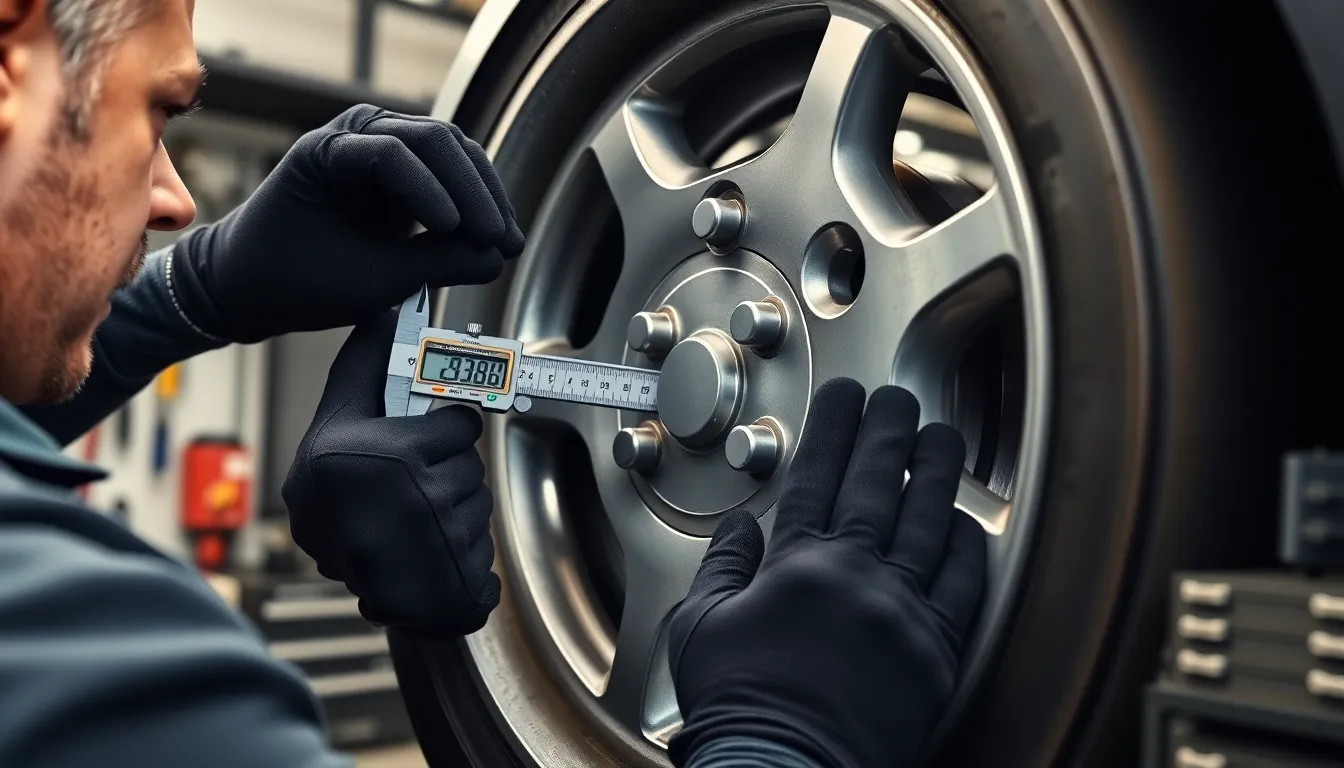
Measuring 6-lug and 8-lug bolt patterns is straightforward once you understand the proper technique. These even-numbered lug configurations allow for direct measurements across the wheel, making them easier to identify than their odd-numbered counterparts.
Diameter Measurement Technique
The diameter measurement for 6-lug and 8-lug wheels follows a simple center-to-center approach. Place your measuring tool at the center of one lug hole and extend it directly across to the center of the opposite hole. This measurement gives you the bolt circle diameter (BCD) that forms part of your bolt pattern specification. Digital calipers provide the most accurate readings, displaying the precise distance between opposing lug holes. For 6-lug patterns, common measurements include 5.5 inches (139.7mm) found on many trucks and SUVs, while 8-lug patterns typically measure 6.5 inches (165.1mm) or 170mm on heavy-duty vehicles.
Using Bolt Pattern Charts
Bolt pattern charts serve as valuable reference tools after taking your measurements. Compare your obtained measurements against manufacturer-exact charts to confirm you’ve identified the correct pattern for your vehicle. These charts list standard bolt patterns by vehicle make and model, helping eliminate any measurement errors. Many online resources offer comprehensive bolt pattern databases where you can cross-reference your findings. Automotive parts retailers also provide these charts, allowing you to verify measurements before purchasing new wheels. The exact specification format follows the number of lugs followed by the diameter—for example, 6×139.7mm for many pickup trucks or 8×165.1mm for certain heavy-duty applications.
Common Bolt Pattern Standards

Bolt pattern standards vary significantly across different regions and vehicle manufacturers. These regional differences reflect manufacturing traditions and design philosophies that have evolved over decades in the automotive industry.
North American Standards
North American bolt patterns frequently combine imperial and metric measurements, creating unique specifications. Popular patterns include 5×4.5″ (5×114.3mm), 5×5″ (5x127mm), and 6×5.5″, which are common on domestic trucks and passenger cars. Most American manufacturers standardize their lug patterns across multiple vehicle models, making wheel interchangeability more straightforward within a brand’s lineup. You’ll notice that even when using inch measurements, many North American specifications have exact metric equivalents that manufacturers reference in technical documentation.
European and Asian Standards
European and Asian manufacturers typically adhere to strict metric measurements for their bolt patterns. Common configurations include 4x100mm, 5x112mm, and 5×114.3mm, which you’ll find on vehicles ranging from compact cars to luxury sedules. These manufacturers prioritize precision in their wheel fitment specifications, rarely converting measurements to imperial units. Asian car makers, particularly Japanese and Korean brands, often use the 5×114.3mm pattern across multiple models, creating a standardized approach that’s become increasingly prevalent in global markets. You’ll find these metric patterns dominate the compact and mid-sized car segments, with consistency that makes aftermarket wheel shopping more straightforward.
Bolt Pattern Conversion Options
When your desired wheels don’t match your vehicle’s bolt pattern, you’re not out of luck. Several conversion answers exist to help you achieve the perfect fitment while maintaining safety and performance.
Adapter Plates and Spacers
Adapter plates provide an effective solution for bolt pattern mismatches by creating a secure interface between your vehicle’s hub and incompatible wheels. These metal plates bolt onto your existing hub assembly and feature a new set of lug holes arranged in the pattern required by your wheels. Most quality adapters are precision-machined from aircraft-grade aluminum or steel to maintain structural integrity under driving conditions. Installation requires proper torque specifications to ensure the adapter remains securely attached to both the hub and wheel, preventing dangerous loosening during operation.
Wheel spacers serve a dual purpose in many conversion applications. Their primary function is adjusting wheel offset to improve clearance or alter vehicle stance, but certain spacer designs also incorporate bolt pattern conversion capabilities. These combination units push the wheel outward from the hub while simultaneously adapting the bolt pattern. Keep in mind that adding spacers changes your wheel’s effective offset, potentially affecting handling characteristics and putting additional stress on wheel bearings and suspension components.
Custom Wheel Options
Custom-manufactured wheels offer the most integrated solution for bolt pattern compatibility issues. Reputable wheel manufacturers can produce wheels with virtually any bolt pattern configuration customized specifically to your vehicle’s requirements. This option eliminates the need for adapters or spacers entirely, maintaining the original engineering specifications and weight distribution of your vehicle.
Premium wheel shops provide comprehensive consultation services to determine the ideal specifications for your custom wheels, including not just bolt pattern but also width, diameter, offset, and load rating. The manufacturing process typically involves CNC machining or casting with precise quality control measures to ensure each wheel meets exact specifications. Though custom wheels represent a higher initial investment than adapters, they often prove more cost-effective long-term by avoiding the potential complications associated with conversion hardware and preserving your vehicle’s factory handling characteristics.
Conclusion
Determining your wheel’s bolt pattern doesn’t have to be complicated with the right approach and tools. Whether you’re measuring a 4-lug compact car or an 8-lug heavy-duty truck you now have the knowledge to identify this crucial specification accurately.
Remember that precision matters when measuring bolt patterns. Even small errors can lead to wheels that simply won’t fit your vehicle. Digital calipers offer the best accuracy but a simple tape measure can work in a pinch.
If you encounter compatibility issues bolt pattern adapters or custom wheels provide answers though each comes with considerations. Always verify your measurements against manufacturer specifications before making a purchase.
Armed with this knowledge you’ll shop for wheels with confidence knowing exactly what fits your vehicle and avoid costly returns or safety issues.
Frequently Asked Questions
What is a wheel bolt pattern and why is it important?
A wheel bolt pattern refers to the arrangement of lug holes on a wheel. It consists of two numbers: the number of bolt holes (4, 5, 6, or 8) and the diameter of the circle formed by these holes. This measurement is crucial for proper wheel fitment, safety, and performance. Using wheels with incorrect bolt patterns can lead to unsafe driving conditions and potential vehicle damage.
How do I measure a 4-lug bolt pattern?
For a 4-lug pattern, measure from the center of one lug hole directly across to the center of the opposite hole. This gives you the bolt circle diameter (BCD). Use digital calipers for the most precise measurement. Express your final measurement as “4x” followed by the diameter in millimeters (e.g., 4x100mm for many compact cars).
What’s the best way to measure a 5-lug bolt pattern?
Use the pentagon method for 5-lug patterns: measure from the center of one lug hole to the outer edge of the second hole (not adjacent, but skipping one hole). This creates a pentagon shape for accurate measurement. Digital calipers provide the most precise readings. Common 5-lug patterns include 5×114.3mm for many sedans and SUVs.
How do I measure 6-lug and 8-lug bolt patterns?
For 6-lug and 8-lug patterns, measure directly across from the center of one lug hole to the center of the opposite hole. These even-numbered patterns allow for straightforward diameter measurements. Common measurements include 6×139.7mm (5.5 inches) for trucks and 8×165.1mm (6.5 inches) for heavy-duty vehicles.
What tools do I need to measure bolt patterns accurately?
You’ll need basic measurement tools like a standard ruler or tape measure, but digital calipers are recommended for precision as they display both imperial and metric units. For even better accuracy, consider investing in a specialized bolt pattern gauge with adjustable arms that fit into lug holes and instantly reveal the bolt circle diameter.
Do bolt patterns differ between vehicle manufacturers?
Yes, bolt patterns vary significantly across regions and manufacturers. North American vehicles often use combined imperial/metric measurements like 5×4.5″ (5×114.3mm), while European and Asian manufacturers typically use metric measurements such as 4x100mm and 5x112mm. Asian car makers frequently standardize on 5×114.3mm patterns.
What options do I have if my desired wheels don’t match my vehicle’s bolt pattern?
You have three main options: adapter plates that create an interface between your hub and incompatible wheels; wheel spacers that can adjust offset while potentially converting bolt patterns; or custom wheels manufactured to your specific requirements. Adapter plates and spacers require proper installation to maintain safety.
Why is accurate bolt pattern measurement so important?
Accurate measurement prevents costly mistakes when purchasing new wheels. Even small measurement errors can lead to improper installation, unsafe driving conditions, and potential vehicle damage. Knowing your exact bolt pattern helps narrow your search for compatible wheels, saving time, money, and frustration associated with returns.