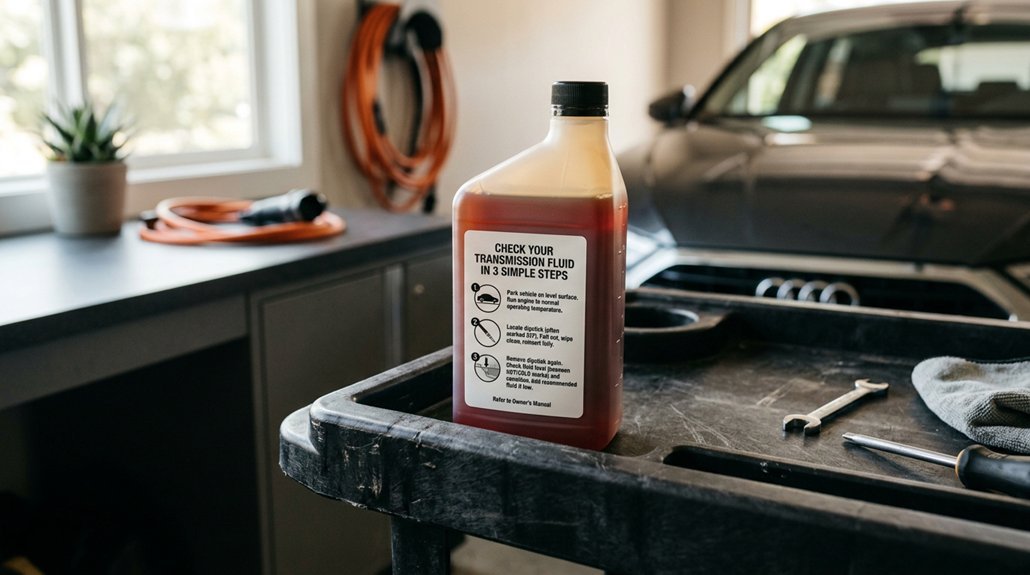
I check my transmission fluid quarterly because I’ve learned the hard way that a $30 quart of fluid beats a $4,000 rebuild. You warm the engine, pull the dipstick, and read the level, simple, except manufacturers now hide dipsticks or seal transmissions entirely.
I measure color against a paper towel: bright red means healthy, brown signals heat damage, and metallic particles mean trouble. Yesterday I caught a slow leak at 87,000 miles just by smelling burnt fluid during my routine.
Whether you’re topping off yourself or heading to a shop for sealed units, knowing these three steps keeps your drivetrain alive longer than most owners bother to check. The real question is what’s hiding in your transmission right now.
Warm Up, Park, and Locate Your Transmission Fluid Dipstick (or Check If You Have One)
Why does transmission fluid checking trip up so many DIYers? I’ve found it’s usually because they skip the warm up phase or hunt for a transmission fluid dipstick that doesn’t exist.
First, I always run the engine until it hits normal operating temperature, about 10-15 minutes of driving. Cold fluid gives a false level reading, and nobody wants that. Then I park on level ground, set the transmission to PARK or NEUTRAL per my vehicle’s specs.
Now comes the hunt. I pop the hood and scan toward the firewall for the dipstick, usually marked with a transmission symbol. Here’s the catch: some newer vehicles use sealed transmissions with no owner-accessible dipstick. If I can’t locate one, I check my manual before forcing anything.
For accessible units, I’ll pull the dipstick, wipe it, reinsert, and check where the fluid hits the level indicator for my baseline level check.
Recommended Products

Fit for Honda Accord 2003-2007, CRV 2007-2014, Civic 2014-2021, Fit 2015-2020, HR-V 2016-2021.

Buyer's Guide: Compatible with Nissan 2007-2024 Altima 2.5L/4cyl, 2015-2024 Rogue 2.5L/4cyl non-hybrid, 2017-2019 Rouge Sport 2.0L, 2017-2019 Sentra 1.6L/4cyl Turbo only, please refer to the details page for more specific information on the applicable models, please be careful check before purchasing to avoid the product being unusable

📣【Buyer's Guide】 Compatible with Nissan 2007-2024 Altima 2.5L/4cyl, 2015-2024 Rogue 2.5L/4cyl non-hybrid, 2017-2019 Rouge Sport 2.0L, 2017-2019 Sentra 1.6L/4cyl Turbo only, please refer to the details page for more specific information on the applicable models, please be careful check before purchasing to avoid the product being unusable.
Check Transmission Fluid Level and Interpret Color, Smell, and Debris
How do I know if my transmission fluid is actually doing its job? I pull the dipstick, wipe it clean, reinsert fully, and pull again to run the level check procedure against that FULL indicator line. I’m checking on level ground with the engine warm and running, just like we all should.
The transmission fluid level tells part of the story. I examine the fluid color next: healthy fluid shows that bright reddish-pink, while dark brown or black signals wear that needs attention. I also note any smell and debris; burnt odors or metal particles mean trouble’s brewing.
If my vehicle lacks an accessible dipstick, sealed transmissions require model-specific professional guidance for proper assessment. A clean dipstick ensures accurate readings, so I always wipe, reinsert, and recheck to confirm both level and condition before making any decisions.
Recommended Products

EASY TO READ :Clear marks on the metal tip promise easy-to-read oil levels.
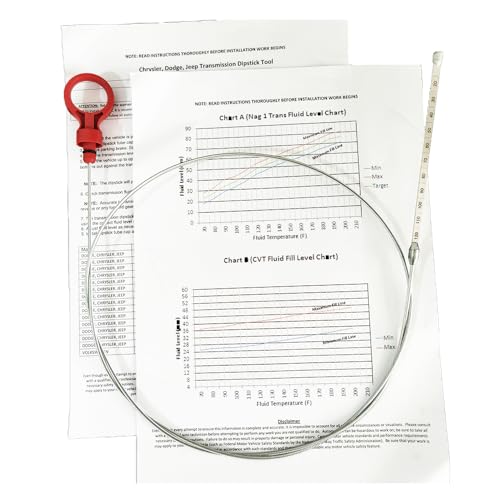
Replacement Part #: 8863B, 9336, 9336A, 917-327 42RLE, NAG1, 45RFE, 62TE.

Compatibility---Compatible with 6F24&948TE automatic transmission
Add Fluid, Watch for Leaks, or See a Mechanic
So what do I do once I’ve checked the fluid? If my transmission fluid reads low on the dipstick, I’ll grab the exact type my owner’s manual specifies and perform a careful top-off. Using the wrong fluid wrecks internals, so I double-check that spec.
Next, I scan for leaks. I slide under and hunt for red, thin spots or oozing on the pavement, clear signs of trouble needing repair.
Slide underneath and hunt for red, thin spots or oozing on the pavement—clear signs of trouble needing repair.
For color checks, I wipe the dipstick on clean white paper. Healthy fluid shows reddish-pink; dark brown or black with a burnt smell means internal damage, not a DIY fix.
If I can’t find a dipstick or my transmission’s sealed, I don’t guess. I consult model-specific guides or head straight to a mechanic for proper assessment.
Recommended Products

Accurate Chlorine Test Strips: Ensure safe food service sanitation with our bleach test strips, reading 0–500 ppm. Designed for restaurants, bars, daycare centers, food trucks, commercial kitchens and private well systems. Easy-read color blocks support clear compliance checks for 3-compartment sinks, dishwashers, and sanitizing solutions.

Accurate Quat Test Strips: Verify proper sanitizing strength with quaternary test strips measuring 0–500 ppm (0, 10, 25, 50, 100, 200, 400, 500). Made for daily use in food-service kitchens, classrooms, gyms, care facilities, and daycares to support health-department compliance.