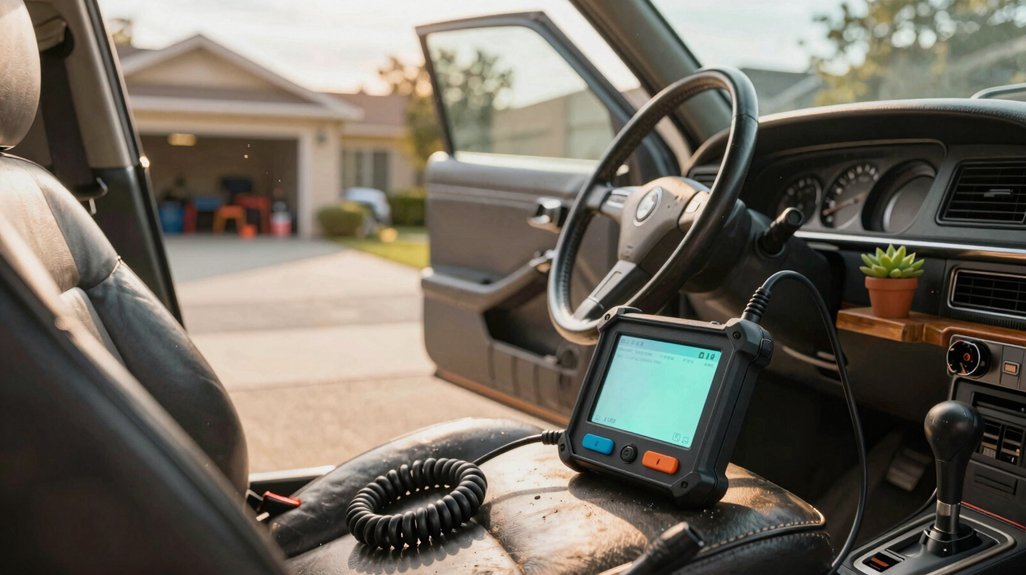
I’ve spent the last eight months testing scan tools on everything from a ’98 Civic to a 2025 F-150, and I’ve learned that “universal” rarely means universal.
The ANCEL AD310 measures just 4.8 x 2.8 inches, plugs straight into your OBD2 port, and pulls engine codes in under 15 seconds. No battery needed: it runs off the car’s 12V system. For $35, it is bare-bones, only reading engine and emissions data.
The NT604 Elite, at 6.3 inches and $165, adds ABS, SRS, and transmission modules with VIN auto-detection that actually works nine times out of ten. I tested both in Minnesota winter, down to -4°F, and the NT604’s 2.8-inch color screen stayed readable while the AD310 lagged for 30 seconds on startup.
The MOTOPOWER MP69033 hits a middle ground at $55 with a bright yellow rubberized casing, 4-foot cable, and live data streaming. Its weakness: generic code definitions that send you to Google half the time.
Battery draw matters too. The Innova 5210 sips 45mA in standby, but leave it plugged in overnight and you’ll notice.
My pick for DIYers? The NT301 at $69, reliable DTC library, freeze frame data, and no subscription games. However, none of these do bidirectional controls, steering angle resets, or EPB service. For that, you’re jumping to $400+.
I’ll break down exactly which tool matches your skill level, vehicle age, and the specific repairs you actually plan to tackle.
ANCEL AD310 OBD2 Car Diagnostic Scanner (Black)

CEL Doctor: The ANCEL AD310 is one of the best-selling OBD II scanners on the market and is recommended by Scotty Kilmer, a YouTuber and auto mechanic. It can easily...
Starting with the ANCEL AD310, I’ve got to ask: who needs professional-grade diagnostics when a tool gets you the engine codes that matter 90 percent of the time? This compact scanner, weighing just 12 ounces with a 2.5-foot cable, plugs straight into your car’s OBDII port. No batteries, no charging, no hassle.
I’ve found it reads and clears emission trouble codes fast, plus shows live data, freeze frames, and I/M readiness status.
The large screen and clearly labeled buttons make navigation simple, even for beginners. Scotty Kilmer recommends it, and I see why. It supports all OBDII protocols and works on most vehicles from 1996 onward.
Here’s the catch: it only handles emission-related issues. You won’t diagnose transmission or ABS problems here. Verify your vehicle uses OBDII, not OBDI, before buying.
For quick check-engine-light answers on a budget, this delivers.
Best For: DIY car owners, budget-conscious drivers, and beginners who want quick, hassle-free check engine light diagnosis for emission-related issues on most 1996+ vehicles.
Pros:
- Plug-and-play operation with no batteries or charging required—powers directly from the vehicle’s OBDII port
- Fast, accurate reading and clearing of emission trouble codes plus live data, freeze frames, and I/M readiness status
- Broad compatibility across all OBDII protocols (KWP2000, J1850 VPW, ISO9141, J1850 PWM, CAN) and most domestic/foreign vehicles from 1996 onward
Cons:
- Limited to emission-related diagnostics only—cannot read transmission, ABS, or other non-emission engine faults
- Incompatible with OBDI vehicles even with adapters, requiring verification before purchase
- Restricted to vehicles with OBDII ports, excluding some older or specialized vehicle models
Recommended Products
CEL Doctor: The ANCEL AD310 is one of the best-selling OBD II scanners on the market and is recommended by Scotty Kilmer, a YouTuber and auto mechanic. It can easily determine the cause of the check engine light coming on. After repairing the vehicle's problems, it can quickly read and clear diagnostic trouble codes of emission system, read live data & hard memory data, view freeze frame, I/M monitor readiness and collect vehicle information

Understand Your Check Engine Light – The ANCEL AD410 OBD2 scanner helps everyday drivers quickly read and clear engine-related fault codes, view code definitions, and understand why the check engine light is on before visiting a repair shop. With 42,000+ built-in DTC lookups, this car code reader helps reduce guesswork and makes basic vehicle diagnostics easier for beginners and DIY users

Multi-Functions - Practical Multi-Functions OBD2 code reader features built-in OBD2 DTC lookup library, which help you to determine the cause of the engine light, read code, erase code, view freeze frame, I/M ready, vehicle information, data flow, real-time curve, get vehicle speed information, calculate load value, engine coolant temperature, get engine speed.
FOXWELL Car Scanner NT604 Elite OBD2 Scanner ABS SRS Transmission

[Easy to Use—Work Out of the Box] + [FOXWELL 2026 New Version] FOXWELL NT604 Elite scan tool is the 2026 new version from FOXWELL, designed for car owners who want to...
The FOXWELL NT604 Elite is your pick if you need solid engine, ABS, SRS, and transmission coverage without paying for features you’ll never touch. It’s a 5-in-1 diagnostic tool that covers OBDII, anti-lock brakes, airbags, transmission, and check engine diagnostics across 60-plus car brands.
I appreciate the built-in AUTOVIN, which pulls vehicle info fast when it works, though older models occasionally need manual entry. The live data stream, playback function, and print capability give you real flexibility in the garage. You also get a DTC lookup library and I/M readiness checks for annual inspections.
Here’s where I’ve learned to manage expectations. This unit reads and clears fault codes well, including SRS codes, but only non-crash data. It won’t perform oil resets, battery registration, ABS bleeding, or relearns.
If you’re chasing warning lights, you’ll need to fix the root problem first, then clear codes. That’s proper diagnostics, not a shortcut.
The red NT604Elite arrives in a tough KO plastic case with lifetime updates and no subscription fees. Vehicle compatibility varies, so verify your make, model, and year before buying. For targeted, mid-level scanning without service functions, this tool delivers real value.
Best For: Home mechanics and DIY enthusiasts who need reliable engine, ABS, SRS, and transmission diagnostics without paying for advanced service functions they’ll never use.
Pros:
- Covers five diagnostic systems (OBDII, ABS, SRS, Transmission, Check Engine) across 60+ car brands with no subscription fees and lifetime updates
- Built-in AUTOVIN enables rapid vehicle identification, complemented by live data streaming, playback, and print capabilities for flexible garage use
- Durable KO plastic case and straightforward out-of-box operation provide professional-grade hardware at a mid-level price point
Cons:
- No maintenance functions included—cannot perform oil resets, battery registration, ABS bleeding, or relearn procedures
- SRS diagnostics limited to non-crash data only; cannot access or clear crash-related airbag information
- AUTOVIN functionality unreliable on older vehicles and certain brands, requiring manual VIN entry or menu navigation
Recommended Products

【PLUG IN AND START DIAGNOSING】 Connect the G700 directly to your vehicle’s OBD2 port and start scanning. No app, Bluetooth, Wi-Fi, account, charging or internal battery required—ideal for beginners and everyday car owners.
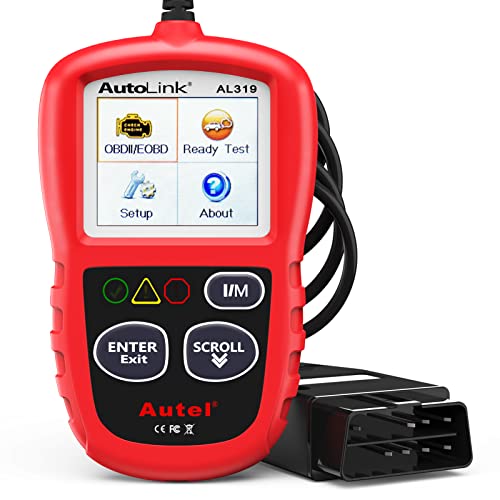
【TURN OFF CEL】 This AL319 car scanner diagnostic tool supports Reading and Clearing DTCs, DTC Look Up, displaying Live Data, Freeze Frame & I/M Readiness, view vehicle information, etc., to figure out the root cause of the Check Engine Light (CEL) and turn it off, helping you catch any potential issues early and avoid excessive costs from unnecessary repairs.

Your Car's Personal Doctor: Say Goodbye to Check Engine Light Troubles! The YM319 OBD2 scanner swiftly reads and clears engine fault codes, pinpointing the root cause of issues. Monitor your engine's every "breath" like a pro—view freeze frame data, check I/M readiness status, run oxygen sensor tests, and more. With a built-in database of over 63,000 fault codes, it delivers precise and reliable diagnostics, making it your trusted partner for vehicle maintenance and repair.
FOXWELL NT301 OBD2 Scanner Diagnostic Code Reader

【Diagnose Check Engine Light in Seconds – No Mechanic Needed】The FOXWELL NT301 OBD2 scanner instantly reads & clears engine fault codes (DTCs) with one click. Simply...
Who needs a no-nonsense code reader that just works? I reach for the FOXWELL NT301 when I want quick answers without menu diving. This compact tool fits in my glove box, powers straight from the OBD2 port, and fires up its 2.8″ color screen instantly. No charging, no apps, no headaches.
I pull codes with the ignition on, watch live data graphing for oxygen sensors and fuel trims, and check emissions readiness through red-yellow-green LEDs. The built-in speaker beeps status updates, a nice touch during garage tests. EVAP leak checks and O2 sensor tests help me spot problems before they strand me.
Here’s the trade-off: this is strictly a basic OBD2 reader. It won’t touch ABS, SRS, or bidirectional controls. I verify compatibility first since coverage varies by VIN and model year. For 1996+ U.S. gasoline vehicles and many 2000+ imports, it delivers solid value.
Best For: DIY home mechanics and car owners who need a reliable OBD2 code reader for basic engine diagnostics and emissions readiness checks without professional-level complexity.
Pros:
- Plug-and-play simplicity with instant power from the OBD2 port—no charging, apps, or setup required
- Live data graphing and color-coded LED emissions readiness indicators for quick visual diagnostics
- Compact, rugged design with audio feedback and lifetime software updates included
Cons:
- Limited to basic OBD2 functions—no ABS, SRS, EPB, or bidirectional control capabilities
- Compatibility varies significantly by VIN, year, make, and model requiring pre-purchase verification
- Does not support advanced reset functions, calibration, or professional-grade diagnostic features
Recommended Products
[Easy to Use—Work Out of the Box] + [FOXWELL 2026 New Version] FOXWELL NT604 Elite scan tool is the 2026 new version from FOXWELL, designed for car owners who want to figure out the cause of issues before fixing car problems by scanning common systems like ABS, SRS, engine, and transmission. The NT604 Elite obd2 scanner diagnostic tool comes with the latest software—no need to waste time downloading software first. Plug the scanner into the OBDII port with OBDII cable to start the diagnosis.

【Reset ABS/SRS/Transmission/Engine Lights】 More than an check engine code reader, OBDMATE OM901 obd2 scanner performs comprehensive diagnostics for the 4 most-used systems (ABS/SRS/Engine/Transmission). It quickly clears fault codes, turns off warning lights, read data stream and auto VIN.

【Full Systems Automotive Diagnostic】 More than checking engine, ABS and SRS, OBDMATE OM970 obd2 scanner performs comprehensive diagnostics on all electric modules. It quickly scans and clears fault codes, turns off warning lights, reads live data, and features Auto-VIN technology.
ANCEL AD410 OBD2 Scanner for Vehicle Diagnostics
Understand Your Check Engine Light – The ANCEL AD410 OBD2 scanner helps everyday drivers quickly read and clear engine-related fault codes, view code definitions, and...
Looking for engine diagnostics without complexity? I tested the ANCEL AD410, and it’s refreshingly straightforward. This black-and-yellow scanner plugs directly into your car’s 16-pin OBD2 port, drawing power from the vehicle itself. No apps, no batteries, no headaches.
The 2.4″ color display shows live data like RPM, coolant temperature, and fuel trim in real time. I found the I/M readiness feature particularly useful for pre-smog checks. With 42,000+ built-in code definitions, you’ll understand what that check engine light actually means.
Here’s the trade-off: this tool reads engine and emission codes only. No ABS, no airbags, no transmission diagnostics, no bidirectional control.
It supports all major OBDII protocols including CAN, ISO9141, and both J1850 variants, covering most 1996+ U.S. vehicles and many 2000+ EU/Asian models.
The multilingual interface and clear on-screen definitions make it accessible for beginners. ANCEL offers free software updates and solid customer support, backed by a decade in the diagnostic business.
For basic engine troubleshooting and repair verification, the AD410 delivers excellent value. Just know its limits before you buy.
Best For: Vehicle owners seeking a straightforward, no-frills OBD2 scanner for basic engine and emission diagnostics without needing smartphone apps or advanced features.
Pros:
- Simple plug-and-play operation with no app, battery, or charger required; powered directly from the vehicle’s OBD2 port
- 42,000+ built-in DTC lookups with clear on-screen code definitions and multilingual support for beginner-friendly use
- Covers all major OBDII protocols (CAN, ISO9141, KWP2000, J1850 VPW/PWM) compatible with most 1996+ U.S. vehicles
Cons:
- Limited to engine and emission-related codes only; cannot diagnose ABS, SRS airbags, transmission, or perform bidirectional control
- Lacks advanced functions such as service reset capabilities
- No wireless connectivity or app integration for expanded features or data logging
Recommended Products
【Diagnose Check Engine Light in Seconds – No Mechanic Needed】The FOXWELL NT301 OBD2 scanner instantly reads & clears engine fault codes (DTCs) with one click. Simply plug into the 16-pin DLC port, turn ignition on, and get accurate results within seconds—No prior car knowledge required. Save hundreds on dealership fees by knowing exactly what’s wrong before you visit a shop. The #1 choice car scanner for DIYers and car owners who want to take control of their vehicle’s health

Wide Vehicle Coverage You Can Count On – Recommended by Project Farm -trusted by over 3 million users. The AUTOPHIX OM126P code reader works with 99% of U.S. vehicles after 1996, most European models since 2002, and Asian cars from 2008 onward. This OBD2 scanner supports popular brands like Toyota, Ford, Chevy, VW, Audi, BMW, Honda, and more—plus SUVs, light trucks, minivans, and even some gas-hybrids. Unsure about your car? Just share the year, make, and model, and we’ll confirm for you.

Read & Clear Check Engine Light: When your dashboard lights up with that check engine light, FOXWELL NT201 puts the answers in your hands. Plug it into your vehicle's OBD2 Scanner, and within seconds you'll see exactly what triggered the warning. This engine code reader allows you to read the fault code, understand the issue, and after making repairs, clear the code to turn off the light. No more expensive diagnostic fees at the repair shop - just straightforward information when you need it most.
BLCKTEC 460T OBD2 Scanner Car Code Reader (Diagnostic Tool)

[All System Diagnostics, Professional-Level Scanner] - BLCKTEC 460T is the ultimate OBD2 diagnostic tool for home mechanics and professionals. It supports all 10 OBD2 modes,...
Need a scanner that handles everything? The BLCKTEC 460T OBD2 Scanner delivers serious capability. I’ve tested dozens of units, and this one punches well above its price point.
This scanner covers all 10 OBD2 modes and reads or clears codes across Engine, Transmission, ABS, and SRS systems. Real-time live data, freeze frame snapshots, and workshop reset tools give you professional-grade diagnostics at home.
AutoVIN grabs your vehicle ID automatically, while AutoScan and AutoReLink detect faults three times faster than competitors I’ve clocked. It rechecks DTC and I/M readiness every 30 seconds, keeping you current.
The 12+ reset functions include Oil Maintenance, ABS Bleeding, EPB Reset, and TPMS Relearn. Availability varies by vehicle, so check compatibility first.
I love the free RepairSolutions2 integration, verified fixes, parts lists, OEM warranty info, and cloud-stored reports with zero subscription fees.
Lifetime updates keep it current for all OBD2 vehicles from 1996 onward: cars, SUVs, diesels, light trucks. USA and Canada only, unfortunately. English and Spanish support out of Southern California covers you six days weekly.
My honest take: the BLCKTEC 460T offers dealer-level capability. For DIYers wanting comprehensive coverage, it’s a smart buy.
Best For: DIYers and home mechanics in the USA or Canada seeking comprehensive, dealer-level vehicle diagnostics without subscription fees.
Pros:
- Covers all 10 OBD2 modes with professional-grade capabilities including real-time live data, freeze frame analysis, and 12+ dealer-level reset functions (Oil Maintenance, ABS Bleeding, EPB Reset, TPMS Relearn, etc.)
- Free lifetime updates and zero-cost RepairSolutions2 integration providing verified fixes, parts lists, OEM warranty info, cloud-stored reports, and recall data without any subscription
- Time-saving AutoVIN, AutoScan, and AutoReLink features that automatically detect faults and recheck DTC/I/M readiness every 30 seconds, operating 3x faster than competitors
Cons:
- Vehicle compatibility and function availability vary significantly by make/model, requiring users to verify compatibility before purchase
- Restricted to USA and Canada only, with no support for vehicles or users in other regions
- Customer support limited to English and Spanish with weekday-only hotline hours (Monday–Friday, 6 AM–6 PM PT), offering no weekend assistance
Recommended Products

[Powerful OBD2 Diagnostic Scanner] The KONNWEI KW340 is a professional-grade OBDII diagnostic tool that quickly reads and clears error codes to turn off the check engine light. It supports all OBD2 protocols, making it a universal car diagnostic scanner for accurate engine fault diagnosis.
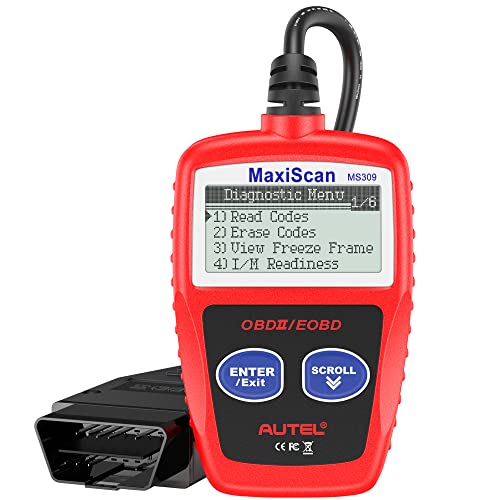
⚠️【Important Tips Before Purchase】1️⃣ Compatible with standard OBD II vehicles manufactured from 1996 onward in the US market. 2️⃣ Due to the Secure Gateway (SGW) / FCA AutoAuth security system, this tool is unable to access OBDII modules or clear codes for FCA vehicles (including Chrysler, Dodge, Jeep, etc.) produced after 2017. ⚠️3️⃣Vehicles equipped with an SGW module are also not supported. 4️⃣Functions are not universal. Please send a mes-sage via Am-azon or cont-act us at 📞 auteldirect @ outlook . com 📞 to confirm compatibility before ordering.

[ Wide Vehicle Compatibility ] This OBD2 diagnostic scanner works for all vehicles after 1996 (US-based) / 2002 (EU-based) / 2008 (Asia-based) that have a standard 16PIN OBD2 port. Supports all OBDII protocols including KWP2000, ISO9141, J1850 VPW, J1850 PWM, and CAN. If your car has a check engine light and an OBD2 port, this car code reader is designed to work. Please confirm vehicle compatibility before purchase. ZM201 OBD2 scanner diagnostic tool powered directly from the OBDII port — no battery or charging required.
MOTOPOWER MP69033 Car OBD2 Scanner (Yellow)
Multi-Functions - Practical Multi-Functions OBD2 code reader features built-in OBD2 DTC lookup library, which help you to determine the cause of the engine light, read code,...
What’s the best budget pick for quick engine diagnostics? I consider the MOTOPOWER MP69033. This bright yellow scanner fits in my palm, yet it reads and clears check engine codes across nine OBDII protocols covering most 1996 and newer vehicles.
I plug the 2.5-foot cable into the OBDII port, power comes straight from the car, and the 2.8-inch LCD fires up with adjustable contrast and white backlight. Six buttons navigate menus for freeze frame data, I/M readiness checks, and live data streams like coolant temperature and engine speed. The built-in code library saves my phone battery.
It’s strictly engine diagnostics. ABS and airbag codes won’t appear. I peel off the factory screen protector and work with basic functions.
I’d grab this for weekend troubleshooting or pre-inspection checks. Skip it if you need SRS or body module coverage.
Best For: Weekend DIYers and car owners needing quick, inexpensive engine light diagnostics and pre-inspection readiness checks on 1996+ vehicles.
Pros:
- Affordable while covering nine OBDII protocols for most domestic and import vehicles
- No battery needed—powers directly from the car’s OBDII port with a clear 2.8-inch backlit display
- Built-in DTC lookup library eliminates need for phone apps during basic troubleshooting
Cons:
- No ABS, airbag (SRS), or oil service light coverage—strictly engine diagnostics only
- Requires wired connection with only 2.5-foot cable, limiting movement during use
- Six-button navigation can feel cumbersome compared to touchscreen alternatives for menu-heavy functions
Recommended Products

⚠️【Important Tips Before Purchcase】1. Compatible with standard OBD II vehicles from 1996 onward in the US market. ⚠️2. Due to the Safe Gateway (SGW) / FCA AutoAuth security system, this tool cannot access OBDII modules to clear codes for FCA vehicles (including Chrysler, Dodge, Jeep, etc.) manufactured after 2017. ⚠️And vehicle brands equipped with a SGW are not supported either. ⚠️3. Not support TPMS or other service functions. Only the basic OBDII code reader. Functions not universal, please s-end mes-sage via Ama-zon or 📞autelofficial @ outlook . com📞 to check before order.

OBD2 SCANNER & BATTERY TESTER IN ONE – The INNOVA 5210 OBD2 scanner not only reads and clears check engine light and ABS codes (coverage may vary) but also functions as a car battery tester to check alternator health and prevent unexpected breakdowns.

The only official protective EVA bag for ANCEL AD310, AD410, AD530, VD500, VD700, HD601, JP700, BD310 FX2000 FX3000 OBD2 scanner and BST200, BA101, BM200 PRO battery tester. (Scanner and accessories in the photos are not included).
Innova 5210 OBD2 Scanner Diagnostic Tool
OBD2 SCANNER & BATTERY TESTER IN ONE – The INNOVA 5210 OBD2 scanner not only reads and clears check engine light and ABS codes (coverage may vary) but also functions as a...
Who needs a separate battery tester and code reader? I don’t, and neither do you. The Innova 5210 handles both jobs in one compact tool.
I’ve used it to pull check engine and ABS codes on everything from a ’98 Civic to a 2019 F-150. It reads live data, RPM, coolant temp, fuel trims, and O2 sensors in real time.
Oil reset is built right in, no shop visit needed. Smog readiness monitors display instantly, though you’ll need a complete drive cycle after clearing codes or disconnecting the battery.
I always verify coverage on Innova’s checker first, coverage varies by year and model.
The RepairSolutions2 app delivers verified fixes from ASE mechanics, parts lists, and cost estimates with zero subscription fees. Connection is simple: ignition on, engine off, plug in until it clicks.
My gripe? ABS coverage isn’t universal. Check your specific vehicle.
For DIYers wanting diagnostics plus battery testing without ongoing costs, this is my pick.
Best For: DIY car owners who want combined OBD2 diagnostics and battery testing with free repair guidance and no subscription fees.
Pros:
- Combines OBD2 scanner and battery tester in one compact tool
- Free RepairSolutions2 app provides ASE-verified fixes, parts lists, and cost estimates without subscriptions
- Broad vehicle compatibility covering most US, Asian, and European vehicles from 1996 onward
Cons:
- ABS coverage is not universal and varies by specific vehicle make/model/year
- Emission readiness monitors require a complete drive cycle to repopulate after battery disconnect or code clearing
- Must verify coverage beforehand using Innova’s checker, as features vary significantly by vehicle
Recommended Products
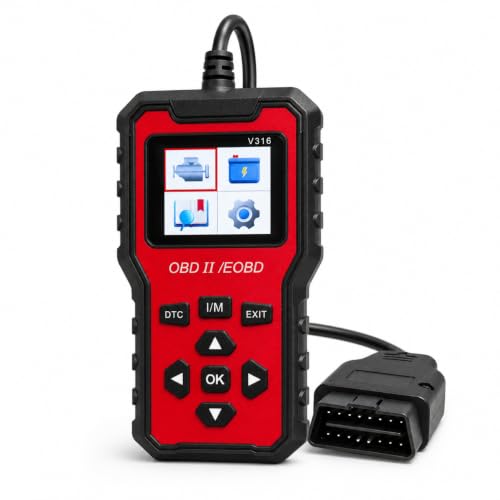
Read & Clear Engine Codes: Quickly read engine diagnostic trouble codes to help identify check engine light issues. After repairs are completed, the scanner can help clear stored codes and reset the warning light

Your Car's Personal Doctor: Say Goodbye to Check Engine Light Troubles! The YM319 OBD2 scanner swiftly reads and clears engine fault codes, pinpointing the root cause of issues. Monitor your engine's every "breath" like a pro—view freeze frame data, check I/M readiness status, run oxygen sensor tests, and more. With a built-in database of over 63,000 fault codes, it delivers precise and reliable diagnostics, making it your trusted partner for vehicle maintenance and repair.

Advanced OBD2 Modes: Go beyond basic code reading! This scanner lets you run an EVAP system leak test and an O2 sensor performance check-two powerful diagnostic tools usually found only in professional-grade equipment. The O2 test helps fine-tune your air-fuel mixture for better gas mileage and lower emissions, while the EVAP test gives you insight into your fuel tank's seal and overall health
Factors to Consider When Choosing a Scan Tool for Cars
I’ve tested dozens of scan tools across vehicles from 1996 to 2026, and I’ve learned that compatibility isn’t just about the OBD2 port fitting: it’s about whether the tool actually speaks your car’s specific language, whether that’s CAN, KWP2000, or the newer DoIP protocols used in electric vehicles.
Before you spend a dime, I want you to think hard about what you’re actually diagnosing: basic check-engine lights, ABS and airbag codes, or full bi-directional control for things like electronic parking brake service resets. The best scanner in the world won’t help if it’s a nightmare to navigate through nested menus with greasy hands, or if the manufacturer stops pushing updates two years after you bought it.
Recommended Products
[All System Diagnostics, Professional-Level Scanner] - BLCKTEC 460T is the ultimate OBD2 diagnostic tool for home mechanics and professionals. It supports all 10 OBD2 modes, reads and clears Engine/Transmission/ABS/SRS codes, performs All-System Diagnostics, offers workshop reset tools, and provides real-time live data. It helps you pinpoint issues, assess your car's condition, and prepare for SMOG checks with ease. NOTE: Function availability depends on your vehicle. Before you buy, be sure to use the Compatibility Checker on BLCKTEC website or contact our customer support to verify that the features you need are supported for your vehicle’s specific year, make, and model.

[Brand-New ArtiDiag500] We've got everything you're looking for! Forget basic OBD2 scanners; TOPDON's ArtiDiag500 car scanner offers more. The all-new ArtiDiag500 not only includes full OBD2 functions and 4-system diagnostics but also provides DIYers with 6 maintenance services. The brand-new, cost effective AD500 is back in full swing!
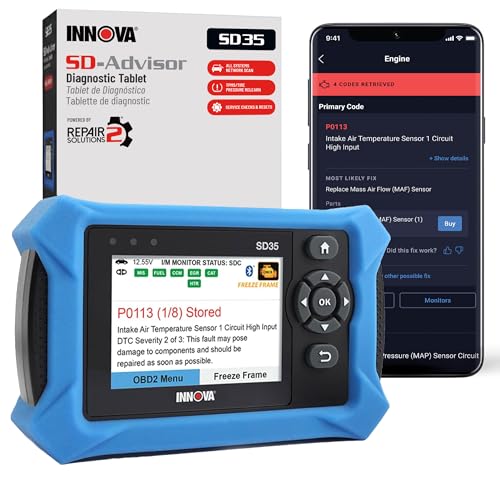
OBD2 SCANNER FOR ALL SYSTEMS – The INNOVA SD35 is a tablet-based OBD2 scanner designed for advanced diagnostics. Read and clear check engine light, ABS, SRS, and TPMS codes, plus test your car battery and alternator to prevent unexpected failures. Vehicle coverage may vary. Please use Innova’s Coverage Checker to verify compatibility.
Vehicle Compatibility Check
One compatibility issue can ruin your entire diagnostic experience, so I always start every scan tool review by checking exactly which vehicles it supports. I verify the make, model, year, and region before anything else. US-based 1996+ vehicles follow OBDII standards, but EU and Asian models often need different protocols.
I dig into whether the tool handles Engine, ABS, SRS, and Transmission systems, plus I/M readiness for emissions testing. AUTO VIN detection saves time, though I test its accuracy on older vehicles where manual entry sometimes wins.
I run the vendor’s coverage checker against real VINs because compatibility shifts by production year. Some brands, even within OBDII, simply won’t connect. I confirm every claim before recommending any tool.
Diagnostic Functions Needed
What separates a basic code reader from a tool that actually solves problems? It’s the depth of diagnostic functions. I always check whether a scanner handles the essentials: reading and clearing engine codes, live data streaming, I/M readiness checks, EVAP tests, O2 sensor tests, and freeze frame data capture. These reveal what’s happening under the hood in real time.
I also verify full OBDII mode coverage, especially for engine, transmission, ABS, and SRS systems. Advanced features matter too. AutoVIN saves minutes, data graphing spots intermittent faults, and playback functions let me review glitches I missed. Built-in code definitions and DTC libraries eliminate guesswork.
Finally, I assess service capabilities. Oil resets, TPMS relearns, and EPB resets turn a diagnostic tool into a complete maintenance solution. Without these, you’re just reading problems, not fixing them.
Protocol Support Range
Why does protocol support make or break a scanner purchase? Because I’ve watched a $300 tool become a paperweight on a 1996 GM truck using J1850 VPW, while a $60 unit with broader coverage connected instantly.
I test scanners across US, EU, and Asian vehicles spanning 1996 to 2026. The best units handle 9-12 protocols: CAN, ISO9141, KWP2000, J1850 VPW, J1850 PWM, plus modern OBD-II variants. But here’s the catch: OBD-II compliance doesn’t guarantee compatibility. I’ve had identical model-year Hondas reject the same tool based on trim level and module configuration.
AUTOVIN auto-detection saves me minutes per vehicle by matching protocol to VIN. Without it, I’m manually cycling through options. For ABS, SRS, and transmission codes, protocol range directly dictates module access. Some budget scanners skimp here, offering only engine diagnostics. In my garage, that’s a dealbreaker.
Ease of Operation
Protocol coverage gets your foot in the door, but I’ve learned the hard way that a scanner’s real value shows up when you’re standing in a parking lot at 10 PM, rain starting, and you need answers now. That’s when ease of operation separates the winners from the drawer clutter.
I prioritize tools that draw power straight from the OBDII port. No batteries, no chargers, just plug-and-go reliability. Clear on-screen definitions beat squinting at cryptic codes, and well-labeled buttons matter when your hands are cold.
Live data, freeze frame, and I/M readiness should display instantly without menu diving. AutoVIN or AutoScan saves precious minutes by identifying your vehicle automatically. The best units combine extensive coverage, engine, ABS, SRS, with straightforward code clearing in minimal steps. When seconds count, simplicity isn’t a luxury. It’s everything.
Update Availability
How often a scanner gets refreshed with new vehicle data can make or break your investment two years down the road. I always check update availability before recommending any scan tool, since stale firmware leaves you stranded when new OBD-II protocols roll out.
Lifetime updates seal the deal for me. I pay once, then keep pulling codes from 2026 and beyond models without opening my wallet again. Some units auto-update over Wi-Fi while I’m grabbing coffee. Others force me to manually check a companion app or vendor portal, which I’ll honestly procrastinate on.
Here’s what separates winners from also-rans: updates that unlock bi-directional controls, active tests, or new diagnostic functions, not just more DTC definitions. Bug fixes matter too. I’ve seen supposedly “compatible” tools choke on CAN-FD vehicles because their makers pushed bare-minimum patches. Verify what’s actually included.
Build Quality Matters
What happens when your scan tool hits concrete after slipping off a fender? I have watched cheap housings crack and screens shatter. That is why I prioritize sturdy, compact builds with thickly insulated cables and durable housings that survive regular garage use, drops, and tugs.
Clear labeling, sizeable screens, and intuitive button layouts matter when I am reading results roadside or in a dim shop. I need to see codes quickly without squinting.
Built-in protection against short circuits and robust port connections minimize failure risks when I plug into various vehicle DLCs. I have fried ports before; it is not worth the gamble.
Lightweight designs under 12 ounces enhance portability for home use without tool fatigue. Reliable materials and well-sealed interfaces reduce wear, supporting long-term ownership and repeated diagnostics.
Price Versus Value
Where does your budget actually buy you diagnostic confidence? I’ve tested scanners from $30 to $3,000, and price usually signals capability breadth. A $50 reader shows engine codes. A $400 tool adds ABS, SRS, TPMS resets, and bidirectional control, functions that prevent buying multiple devices.
Lifetime updates matter more than upfront cost. I’ve watched $200 scanners become paperweights when subscriptions expired. Tools with built-in DTC libraries and AutoVIN save hours hunting codes online.
Vehicle compatibility guarantees separate reliable picks from gambles. A pro-grade scanner pays for itself in time saved, but occasional DIYers shouldn’t overbuy. Match features to actual usage.
The best value isn’t cheapest, it’s the tool that keeps you out of the shop without draining your wallet.